

In this article, I would like to discuss about the various challenges faced by line supervisors and industrial engineers during a style changeover. I have also included some possible solutions to counter measure those challenges.
What is a style changeover?
Changeover is the time between the last good pieces of the previous style to the first good piece from the new style. Getting the first ten good pieces is the main challenge of the changeover. Style changeover can also be measured by the time required to achieve the full efficiency after the changeover.
Process needs to be followed prior style changeover (In a typical factory):
 Planning department release monthly plan based on the order delivery date. From the monthly plan weekly plan is created by the team which is handed over to the HODs of IE, Engineering Department, Production Department and Technical Department. According to the plan all the respective department starts the preparation on that.
What is Bucket Loss?
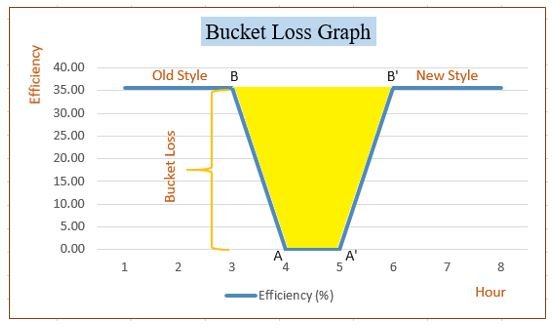
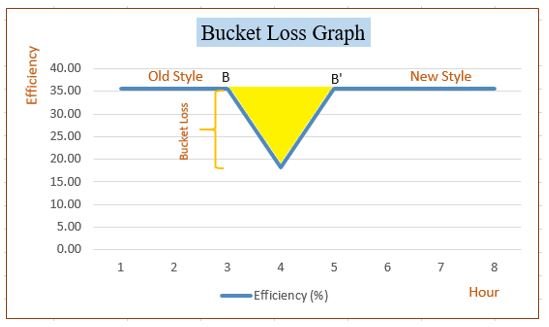
Bucket loss is being noticed when transition happens between the production of two products. It indicates efficiency drop when old style changes to new style.
Why the loss is called bucket loss?
During style changeover, one of the extreme cases which is observed when the efficiency drops down to zero and the same is maintained for some hours, this makes the graph between line efficiency and time looks like a bucket (Figure-1). This is the reason the loss observed is known as bucket loss in style changeover process.
Different scenarios of bucket loss have been shown below.
- Machine pre-setting
- Operator pre-training
- Critical operation identification
- Operator absenteeism forecast
The concept of SMED deals with two elements- External element and Internal element. External elements are those activities which can be performed without disturbing the sewing line. For example setting of the machine which are required in the new style in the pre-setting area prior to feeding.
Whereas internal elements are those activities for which we have to stop the sewing line or sometimes we have to wait until the last piece of the previous style is out. For example, changing some setting of the machines for new style which were present for the previous running style.
The aim is to convert most of the internal activities into external activities so the feeding time will be reduced and quick changeover will be possible.
Related article: How to reduce style changeover time (COT) in garment manufacturing
Challenges faced during style changeover
Industries in which small garments are manufactured specially lingerie; faces frequent style change due to very small SMV. It becomes very challenging for those industries to maintain the efficiency of the line during the changeover period. There are many predictable and unpredictable challenges out of which I am trying to list down few of them:
- Blockage due to previous style
- Sudden Plan change
- Cut panels not ready for the new style during feeding
- Layout not ready
- Trim card delay
- Trims not issued
- External machines not pre-set
- Time to set internal Machine
- Operator allocation
- Operator training during line feeding
- Achieving required quality takes time at initial stage
- No proper monitoring method of the line after feeding
- Communication gap
- Indiscipline in the workers
Checklist of the activities 1 week before style change
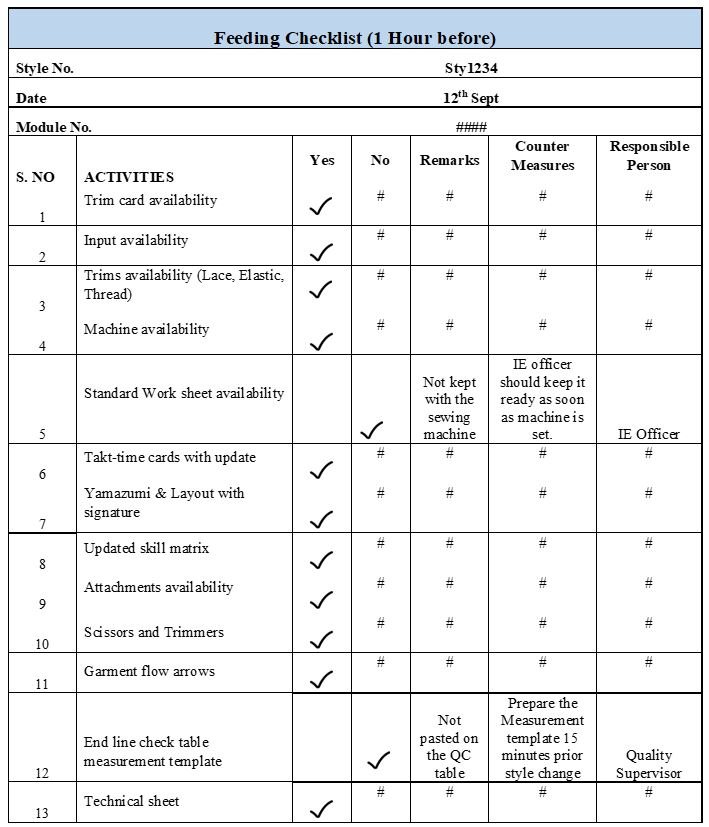
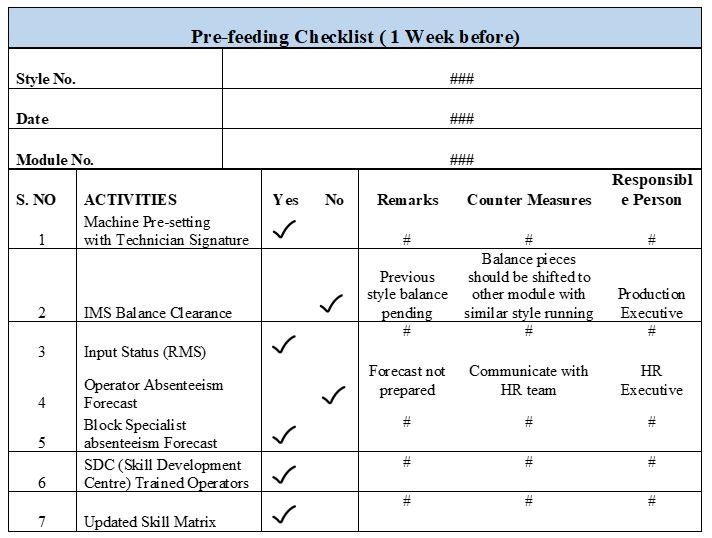 The above checklist is a tool to monitor the style changeover process. Generally, if any activity is not done on time then for that no one wants to take responsibility. One team blames the other, so to avoid that situation it is important to go to the root cause of that issue and the responsible person should find the possible counter measure for that.
Checklist of the activities 1 hour before style change
Conclusion:
Applying the SMED methodology can considerably reduce and channel style changeover time with minimal budgetary impact. Giving merely recommendations for the SMED concept’s application as a style changeover will not be effective if we do not take into account the problems and difficulties.
So, to overcome the issues during style changeover, we need to counter the root causes of the problems.





Leave a Reply