

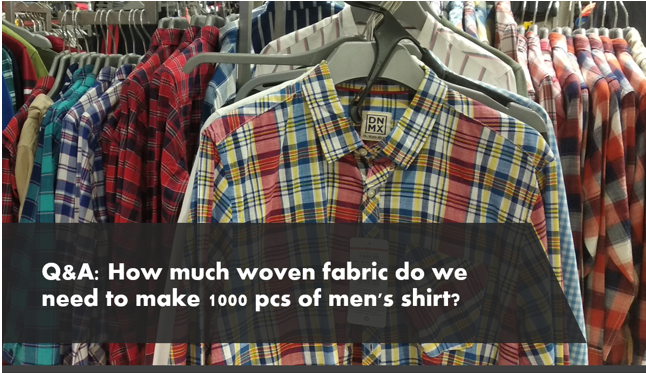
Answer:
I know by asking this question, you are not looking for an exact fabric requirement for woven shirts. To get an idea of woven fabric requirements for men’s shirts follow this.
As per my earlier post, I have shared fabric consumption for a woven shirt. Referring to that fabric requirement per shirt (fabric width 54 inches), you will need fabric for 1000 men’s shirt as following
– Lower side – 1.3 meter x 1000 pieces = 1300 meters
– Higher side – 1.6 meter x 1000 pieces = 1600 meters
So, the fabric requirement for 1000 man’s shirts will fall between 1300 meters – 1600 meters when you go for 54 inches wide fabric.
Important Variables in fabric calculation
The main variables that you need to keep in mind when estimating (calculating) woven fabric requirements are shown here.
1. The shirt spec and size chart. Whether it is a full sleeve formal or casual shirt? Whether it is a half-sleeve shirt. Type of shirt fitting etc.
2. Size ratio in your order – quantity break up of different sizes in 1000 men’s shirts. You can make multiple sizes like Small, Medium, Large, and Excel with a ratio of 1:2:2:1. Or you can make only 3 sizes – Small, Medium, and Large with a ratio of 1:2:2.
3. Another variable of fabric consumption is fabric width. You know the fabric is available in various widths. If you choose a wider fabric, the requirement of linear length will be less and vis-a-versa. When considering fabric width, take the cut-able width for calculation.
4. Production volume: If you cut multiple shirts (shirt components) from a single layer (single marker), the average fabric consumption will be less. It means, if some make only a few pieces of shirts, his average fabric requirement will be higher in comparison to making high volume (1000+ pieces) for the same shirt size (spec).
5. Consider fabric wastages and add wastage allowances with calculated fabric consumption. As we are considering the rectangular shape of each pattern (instead of the actual shape).
Disclaimer: This data is provided here for your reference purpose only. The above calculation is made based on the sum of all pattern areas (considering each pattern is a rectangular shape) and then the area is converted into linear fabric length by diving fabric width. In actual you should estimate fabric calculation based on the pattern marker. Actual fabric requirements may vary depending on the listed variable.
Also read: Shirt measurements from different shirt brands








Leave a Reply