
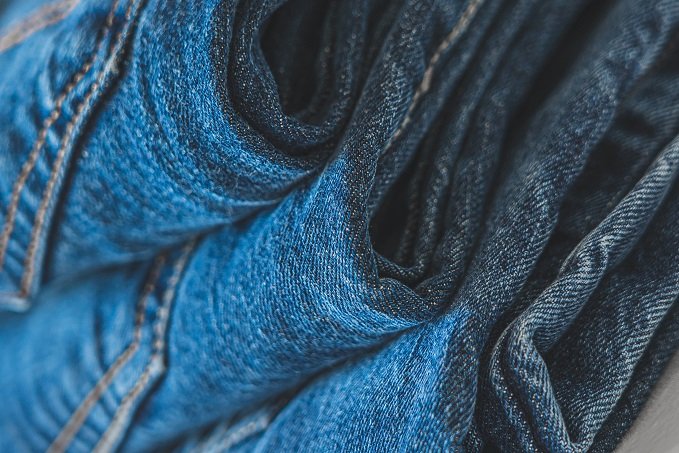
Raw and washed denim require different approval logic in jeans OEM production. A raw jean may leave the sewing line close to its intended selling appearance, while a washed jean still has to pass through processes that can change its dimensions, shade, surface character, and hand feel. This article shows the product fit, shrinkage and approval process between raw vs washed denim.
For brands and merchandisers, the key question is not simply which look to choose. It is which product condition defines the approved fit, how dimensional change will be controlled, and what evidence is needed before bulk production proceeds.
Defining Raw and Washed Denim
Raw Denim
Raw denim jeans generally have not received a garment wash after sewing. However, “raw” does not necessarily mean the fabric is completely untreated. The denim may already have undergone mill finishing, including sanforization to reduce residual shrinkage.
Unsanforized denim requires particular attention because dimensional change during soaking or laundering can be substantial. Even sanforized raw denim can change after washing.
The product specification should therefore identify:
- Whether the fabric is sanforized, unsanforized, or otherwise dimensionally stabilized.
- Whether the finished garment receives any rinse or wet treatment.
- The intended care instructions.
- Whether fit is defined before washing, after washing, or in both conditions.
Terms such as “rigid,” “dry,” and “raw” should not replace a written process description. Rigid often means non-stretch denim; it does not reliably identify washing history.
Washed Denim
Washed denim jeans receive a garment treatment intended to develop appearance, softness, or dimensional stability. Treatments may include rinsing, enzyme washing, bleaching, tinting, and softening, sometimes combined with abrasion, laser work, or other dry processes.
These treatments can affect more than color. They may change seam puckering, fabric strength, pocket positioning, waistband behavior, and leg twist. A washed style must consequently be developed as a fabric-pattern-process combination, not as a sewing pattern with a decorative finish added later.
Establishing the Fit and Shrinkage Basis
Define the measurement condition first
Every measurement chart should state when the garment is measured. Useful conditions include:
- Sewn garment before washing.
- Finished garment after the production wash, drying, and agreed relaxation period.
- Garment after a specified consumer-care laundering test.
For washed jeans, final fit approval normally centers on the production-finished garment. For raw jeans, buyers should approve the selling condition and understand the fit change expected under the stated care method.
Specify measurement methods as well as points of measure. Waistband alignment, garment fastening, measuring tension, and whether a dimension is taken flat or along a curve can all affect results.
Test the actual fabric and process
Do not set pattern allowances from a generic shrinkage percentage. Test the nominated fabric, then validate it in sewn garments using the intended production treatment.
Record lengthwise and widthwise dimensional change separately. Garment construction creates localized behavior: a waistband, multi-layer seam, or pocket opening may respond differently from an unrestricted fabric specimen.
A practical trial should track:
- Fabric article, composition, weight, and lot identification.
- Initial measurements and marked reference points.
- Wash sequence, chemistry, load, temperature, and duration.
- Extraction, drying, and finishing conditions.
- Final measurements after an agreed conditioning period.
For washed styles, distinguish production-wash shrinkage from residual shrinkage during consumer laundering. Passing one check does not establish the other.
Correct the pattern, not just the wash
Pattern compensation should follow measured behavior. Adding the same allowance everywhere can distort rise, knee placement, pocket balance, and leg shape.
If measurements miss the target, investigate the cause before changing the pattern. The problem may be fabric variation, sewing tension, an altered wash load, or excessive drying. Changing the wash solely to recover size may also change shade or handfeel.
Stretch denim needs additional evaluation for stretch, recovery, and growth during wear. A garment can meet its static measurement chart yet lose its intended silhouette after use.
Controlling Shade and Finished Quality (Raw vs Washed Denim)
Actions can be taken to control shade variations in finished denim jeans.
Manage fabric variation before cutting
Denim shade differences can become more visible after washing. Inspect incoming fabric, maintain roll traceability, and group material according to an agreed shade-control method.
Where practical, keep garment components within compatible shade groups. Uncontrolled mixing can produce mismatched panels, waistbands, or pockets that only become obvious after finishing.
For washed styles, representative wash trials help reveal how different fabric lots respond. An approved wash on development fabric does not automatically approve a later bulk lot.
Approve a range, not an undefined impression
A single reference garment is useful but may not describe acceptable bulk variation. Agree on boundary samples or a shade band covering acceptable light and dark limits, tint, contrast, and abrasion intensity.
Assess garments under consistent lighting and viewing conditions. Photographs can support communication, but screen settings and exposure make them unreliable as the sole color standard.
Record approval of:
- Overall shade and cast.
- Contrast at seams and raised areas.
- Whisker, abrasion, and distressed-area placement.
- Handfeel and surface appearance.
- Leg twist, seam puckering, and component matching.
Raw denim also needs appearance controls. Check creasing, pressure marks, sewing damage, shade matching, and finishing consistency rather than assuming an unwashed garment is visually straightforward.
Check performance after finishing
Washing and abrasion can expose or create quality problems. Select tests according to the fabric, construction, finish, intended use, and buyer requirements.
Relevant checks may include dimensional stability, rubbing colorfastness, laundering colorfastness, seam performance, tear strength, and trim function. Dark raw denim deserves particular attention to color transfer.
Inspect heavily treated areas for unintended weakness. Review zipper operation, button attachment, pocket-bag staining, and label legibility after the complete process. Applicable chemical restrictions should also be addressed through the buyer’s compliance program.
Sampling and Approval Gates
Sampling sequences and minimum order quantities vary with fabric availability, wash complexity, and factory capacity; treat them as project-specific planning inputs rather than fixed industry rules.
Gate 1: Development specification
Confirm the fabric, construction, fit block, measurement methods, care method, and intended finish. Separate visual references from mandatory acceptance criteria.
State who can approve changes and how revisions will be recorded.
Gate 2: Fabric and wash feasibility
Review fabric tests and wash trials before committing to a finished appearance. Confirm that the target shade and handfeel can be achieved without unacceptable dimensional or strength changes.
Small trials establish direction; they do not prove bulk repeatability.
Gate 3: Fit and size-set approval
Approve fit in the specified garment condition. Check balance, mobility, rise, waistband comfort, and pocket placement alongside measurements.
Use a size set to verify grading, especially where one pattern adjustment may not work across the full range. Resolve discrepancies between the chart and the actual fit before release.
Gate 4: Pre-production approval
Review a sample made with nominated bulk materials and the intended production route. Retain approved physical references, measurement records, wash instructions, and revision history.
Any material or process substitution should trigger a documented review of the affected approvals.
Gate 5: Pilot and bulk verification
Where feasible, run a production-scale pilot to check machine loading, handling, finishing, and repeatability.
During bulk production, link inspection records to cutting and wash batches. Check measurements and appearance at agreed intervals rather than relying only on final inspection. Quarantine suspect batches until disposition is authorized.
Buyer Checklist Before Bulk Release
Before authorizing production, confirm:
- Is “raw” or “washed” defined by an explicit process description?
- Is the approved measurement condition clear?
- Have production shrinkage and residual laundering shrinkage been evaluated separately?
- Does the approved pattern reflect verified garment behavior?
- Are bulk fabric lots traceable and shade-controlled?
- Are visual limits available for shade and treatment placement?
- Have fit, grading, performance, and trims passed the required checks?
- Are approved samples and documents revision-controlled?
- Is there a clear procedure for substitutions, failures, and re-approval?
In the context of Raw vs washed denim comparison, both types of denim jeans can both be controlled effectively. The essential discipline is to connect fabric behavior, garment construction, finishing, and acceptance criteria before bulk decisions become difficult to reverse.
About the author / Source
This article is contributed by Denim Manufacturer China.
Further reading: https://denimmanufacturerchina.com/resources/raw-vs-washed-denim