

You might be using the formula to calculate standard time, labor productivity, and labor cost per minute.
In the apparel industry, industrial engineers, production managers, and production planners measure the factory performance daily by following a standard formula for each measure. You might be already using such formulas for calculating your factory performance. For example, industrial engineers
- prepare OB sheet,
- measure key performance indicators (KPIs)
- prepare daily reports on factory performance, and
- line performance in terms of productivity and efficiency.
They also measure line capacity as well as individual operator capacity in the given hours. All these are essential for production management, balancing work, and planning production and manpower.
As these are common measures in apparel production, most of the factories use Excel templates to prepare such reports and calculations where the Excel templates are pre-filled with formulas. We just follow the report template. We don’t need to calculate every time we make a report. So, many times we are not clear about how to calculate a particular measure.
Let’s discuss 10 basic production measures and the formula used to calculate those measures.
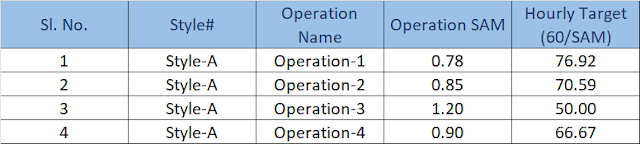
1. Hourly production target
A few examples are shown for calculating hourly production targets at 100% efficiency in the table below.
2. Daily Line Target
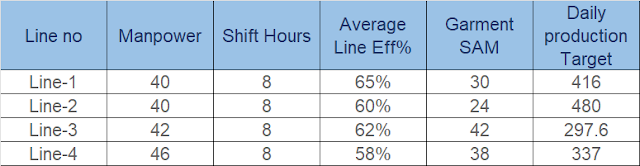
Like the hourly production target, the daily production target of a line is calculated. This target is given to line supervisors. Based on the daily production target production planning and the total production time needed to complete an order are calculated. The following formula is used to calculate the daily line target.
See the example in the following table.
Table -2: Daily production target calculation
3. Individual operator efficiency
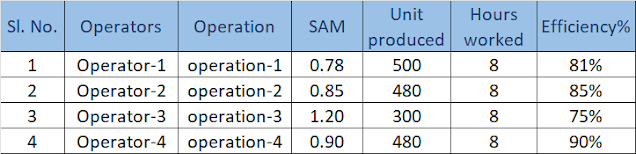
See the following examples (Table 3) for calculating individual operator efficiency. In case an operator is doing more than one operation, first calculate the total minutes produced in each operation and sum up the total minutes produced in all operations by an employee.
Table 3: Examples of individual operator efficiency calculation
4. Line Efficiency
Total hours worked by the line = Number of operators X Shift hours
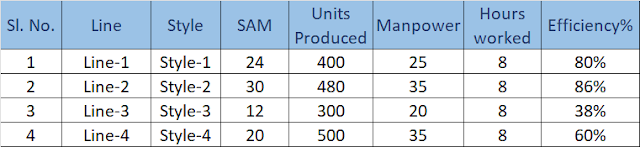
Note: Include helpers and workers doing manual operations in the manpower, in case SAM of the manual operations are included in garment SAM.
The above formula is used majorly for line efficiency calculation. This is known as output-based line efficiency. Line efficiency can be also measured differently. Instead of line output data, individual operators’ produced minutes and hours worked are calculated first, and later their produced minutes and hours worked are summed up to the calculated line’s produced minutes and total hours worked.
5. Machine Productivity
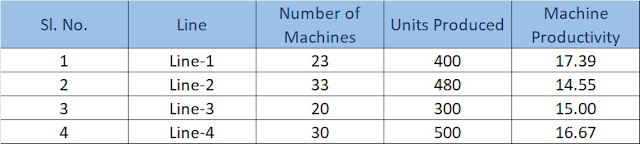
Machine productivity is measured to know the average production per machine per day or in the defined time frame. A line with 48 machines producing 480 shirts and another line with 36 machines producing 400 shirts (same design). How do you figure out which line doing better? This can be answered simply by measuring machine productivity.
Productivity is the ratio of output and input. The machine productivity of a production line is calculated using the following formula.
Machine Productivity= Line output / No. of machine used
Machine productivity is measured as production per machine per shift day. See the following example (Table 5).
6. Labor Productivity
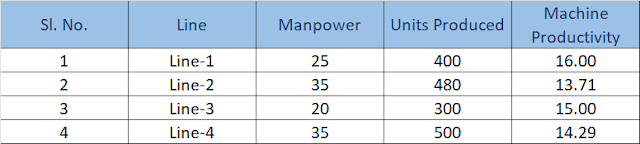
Floor productivity is also measured as labor productivity. Instead of machine input in this case line output is divided by labor input to calculate labor productivity. See the following example of labor productivity calculation in Table 6. Normally, number of manpower utilized in a production will be greater than equal to the machines used in the line. In such cases, labor productivity will be less than machine productivity. In modular lines, line-wise assigned operators can be less than the machine count.
7. Standard Time Estimation
Standard time is the time allowed to an operator to carry out the specified task under specified conditions and defined level of performance. This is a standard definition for standard time. Some additional time is added to the basic time to arrive standard time of a task. In practice, none can work throughout the day without taking a rest. Operators need time for relaxation from fatigue. Various allowances are relaxation allowance, contingency allowance (like machine breakdown), and bundle allowance (for the PBS system).
The basic constituents of standard time are shown in the following chart. This chart shows how standard time is made up of observed time and basic time of a job.
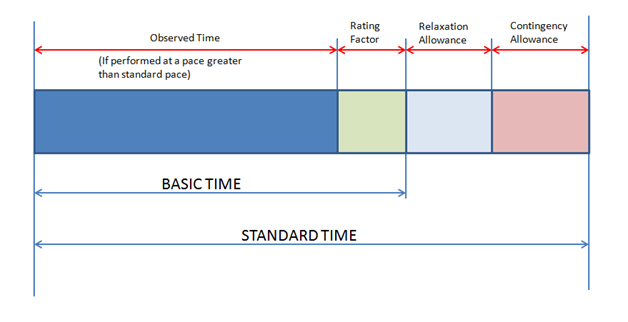 |
Chart-1: This chart shows how standard time is made up. Source: Introduction to work study by ILO
8. Machine utilization percentage
Machines and equipment are primary resources of garment manufacturing units. These resources must be utilized as much as possible to improve factory performance. But due to work unavailability or less work, some machines (like specialized machines) are partially utilized by the factory. In such cases, the same machine is shared for multiple lines. Machine utilization is calculated using the below formula.
9. Labor cost per unit
Labor cost is part of garment FOB. For every order, we have a target labor cost. We need to track the actual labor cost and control it. So we measure it after a style is loaded. Here is the formula to calculate labor cost per garment.
10. Production capacity
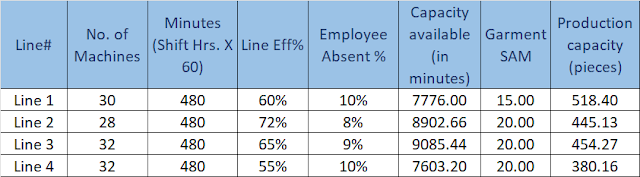
Production capacity is measured in available minutes as well as in the number of pieces. First, we will see how available minutes in a line are calculated. Then we will calculate capacity in the number of garment units per day.
Table 7: Example of production capacity calculation









Comments (1)
Nhung Phạmsays:
September 10, 2026 at 8:20 amThank you for the very useful article; the formulas are clearly explained and can be applied in factories.