

It was just a couple of years back the demand for industrial engineers (IE) increased many times. An industrial engineer can do a lot to improve a company’s performance.
But a fresh student pass-out from educational institutes (Fashion institutes) acquired limited knowledge about the job profile of an Industrial engineer. Most of the jobs are learned in the factory by doing things. There are numerous tools and techniques which are used by industrial engineers to establish an efficient production system in the company.
Without having such tools earlier production managers and line supervisors faced difficulty in measuring work content, garment costing, and production planning correctly, even it was difficult to finalize orders.
Our team has worked to find out important tasks that are important for an engineer and needs a detailed understanding of production fields, included in the following list. Though the job profile of an industrial engineer may vary from one company to another, most of the job profiles fall under the following list.
Industrial Engineers Job Profile in Pointers
- Knowledge about various sewing production systems – An IE must have understanding of the different types of production systems followed by garment factories. Depending on the product type and product volume the production system may vary. In the same time managing production line will also change when moving from one production to another.
- Knowledge of all types of sewing machines necessary for the company – Sewing machines are the main resources of a garment manufacturing unit. In the industrial apparel production various types of sewing machines are for manufacturing a single garment. The selection of the machine depends on garment construction and product types. So, knowledge of sewing machines are must for an IE.
- Time study (Cycle timing) – One of the key task of an IE when you join to a company as a management trainee. So, you need to learn the Time study during your course or you learn it after joining a garment production unit.
- Motion analysis of the operations – Motion analysis is part of method study of sewing and non-sewing operations performed to assemble a garment in bulk production.
- Operation breakdown – Operation breakdown is done during product analysis which is essential task for preparing an operation bulletin and machine requirement calculation.
- Preparation of OB (Operation bulletin) – Operation bulletin is also a task for understanding product construction and many other following tasks are followed based on the operation bulletin, Like, manpower requirement, operators’ skill requirement, machine requirement, line balancing etc. So, you must learn the OB preparation methods.
- SAM Calculation – There are primarily two ways of estimating garment SAM. As an Industrial Engineer, one must have clear concept of Standard Minutes and its right calculation method. Type of allowances to be included during SAM calculation. SAM is the base of performance calculation of individual operators and sewing lines. Also learn the impact of the incorrect SAM of an operation and the garment.
- M/C Layout and Workstation layout – Machine layout is prepared just after operation bulletin is ready and before loading the new order to a sewing line. The line balancing accuracy and line output depends on how the line layout is done for the specific style. Normally, operation sequence and manpower requirement per operations are the defining factory for sewing line layout.
- Line Set up
- Production estimation of a line
- Work Sampling
- Method Study (Seeing Movements of an operation)
- WIP Control
- Line Balancing
- Capacity study
- Cost estimation of a garment
- Developing and Maintaining Skill Matrix
- Incentives schemes
- Calculating Thread Consumption
- Work aids, Guides and Attachment
- Performance Rating
As an IE, you should acquire knowledge and skills in these tools and techniques. You don’t need to implement all IE tools at a time.
First, learn it and practice it and implement step by step.
Learn industrial engineering by reading our tips and how-to guides.
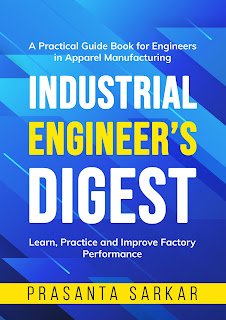
You can also read my book ‘Industrial Engineer’s Digest‘
Almost all work-study tools and methodologies are adopted from others industries and implemented in the garment industry. So each work-study tool has guaranteed benefits if it is used effectively.
Also Read: Role of Industrial Engineers in Garment Production Management






Leave a Reply