
Why the accuracy of garment standard times matters when calculating labour costs and negotiating prices.
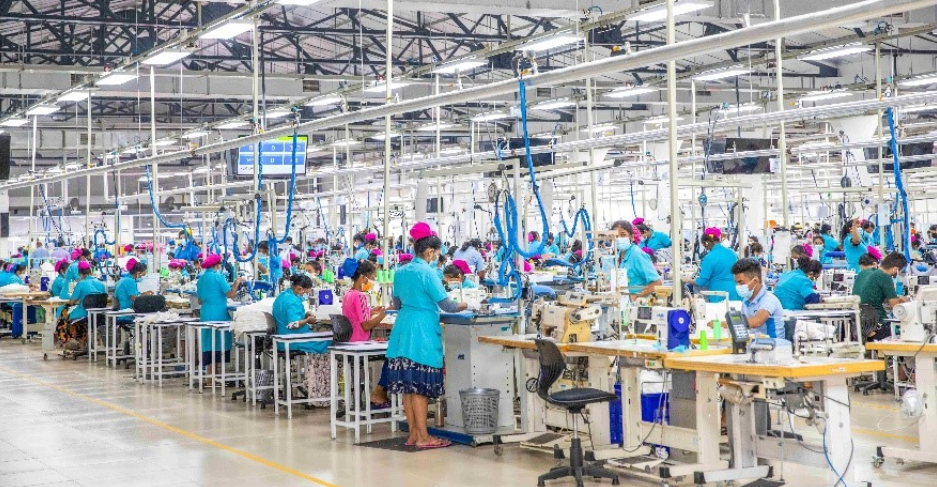
Why living wages have become a costing question
For many years, living wages were discussed primarily in the context of labour standards and social compliance. Increasingly, however, they are also becoming a question of garment costing.
Buyers and manufacturers need to understand not only what workers should be paid, but also whether the price negotiated for a garment provides sufficient allowance to meet the intended labour cost.
This involves two important calculations: the cost of a minute of factory labour and the number of standard minutes required to manufacture the garment.
The first calculation establishes the cost of labour. The second establishes how much labour is required.
Both must be reasonably accurate if the resulting garment price is to reflect the intended labour cost.
Much of the industry discussion focuses on wages. This article examines the other side of the calculation: the reliability of the standard minutes used in garment costing.
What a labour-minute cost tells us
In January 2019, Online Clothing Study published an article about the new labour-minute calculator released by Fair Wear (formerly Fair Wear Foundation) for Bangladesh. A year later, in February 2020, it reported that the tool had been extended to other countries, including India.
In the January 2019 article, its author, Prasanta Sarkar, wrote that he had first heard about the calculator from me when we met in Colombo.
The underlying calculation is straightforward.
A factory’s relevant monthly labour costs are divided by the corresponding available working minutes to establish a labour-minute cost.
Depending on the costing methodology, relevant expenses can include wages, overtime, bonuses, insurance and other employment-related costs.
For example, a factory operating on a regular 48-hour working week has approximately 208 scheduled working hours in an average month:
208 × 60 = 12,480 minutes
This is a simplified illustration per worker. A full factory calculation, as described in Fair Wear’s 2018 paper, also takes into account indirect labour costs, the factory’s total available minutes and its efficiency.
Once the cost of a labour minute is established, it can be applied to the standard minutes required to manufacture a garment.
This provides a way to calculate the labour-cost implication of a proposed wage increase and to understand its effect on garment prices.
But there is an important question: How reliable are the minutes being used in that calculation?
The deep and wide link: where do the minutes come from?
A garment’s standard time should represent a defined manufacturing method under specified working conditions.
For this article, I use the following conventions:
- SMV (Standard Minute Value): The basic standard time established for the operation.
- Allowances: Additional time provided for recognised factors such as personal needs, fatigue and unavoidable delays.
- SAM (Standard Allowed Minute): The standard time including the applicable allowances.
Terminology and calculation conventions can vary between factories, so it is important to state clearly which definition is being used in a costing calculation.
There are three commonly encountered approaches to establishing operation times:
1. Estimates based on experience
An experienced industrial engineer, supervisor or merchandiser estimates the time required for an operation, often using historical data or comparisons with similar garments.
This approach is quick and may be useful during preliminary costing. However, its reliability depends heavily on the experience of the person making the estimate and the quality of the reference information.
Without documented assumptions, it can be difficult for another person to reproduce or independently verify the result.
2. Stopwatch time study
An analyst observes an operator performing an operation and records the time taken over a number of cycles.
The observed time is evaluated with consideration of the operator’s working pace, and appropriate allowances are subsequently applied.
This is a practical method based on actual observation. However, the result can be influenced by the operator selected, the working conditions, the number of observations and the analyst’s assessment.
A study therefore needs to document its method and assumptions if the result is to be reviewed or reproduced.
3. Predetermined motion-time systems
Predetermined motion-time systems approach work measurement differently.
Instead of relying entirely on the time observed for a completed operation, the method analyses the movements and activities required to perform the work.
The relevant motions are classified and assigned time values according to the rules of the particular system. These values are then used to construct the operation time.
The resulting standard can be examined through its underlying motion analysis rather than being represented by a single observed or estimated figure.
However, the reliability of the result still depends on correctly identifying the method, applying the system’s rules and accounting for all relevant elements of the operation.
In their 2018 publication for Fair Wear, Using Due Diligence in Labour Costing to Meet Wage Compliance, Doug Miller and Klaus Hohenegger referred to organisations and methods used in garment work measurement. The paper’s footnotes include the names MTM, General Sewing Data and SewEasy.
Earlier, Doug Miller’s 2013 research for the Capturing the Gains programme had also identified organisations specialising in methods-time measurement in apparel manufacturing.
These approaches have different applications and limitations. The important consideration for a factory is whether the standard time is supported by a sufficiently reliable and documented method.
A costing figure should be explainable when questioned by a buyer, an auditor or another stakeholder.
My contribution to this work
Professor Doug Miller introduced me to Klaus Hohenegger by email in 2019. Klaus came from apparel manufacturing, so we understood each other’s perspectives easily. During the Covid-dominated years of 2020 and 2021 we had lengthy online discussions, with Doug joining most of our meetings, and I contributed standard-minute data covering a range of sewn products to the work associated with Fair Wear’s labour-minute costing calculator. I consulted extensively with Kapila Amarakoon and Rasika Amarakoon, both from Sri Lanka, and Dr. Peter Wilson of the UK — all apparel professionals who form my brain trust.
Klaus travelled regularly to the sourcing countries, and we intended to meet in person soon. We hoped the work would grow into a broader collaboration, but Klaus passed away suddenly in 2022.
A worked example: Join Shoulder
Consider a common garment manufacturing operation: Join Shoulder — joining the shoulder seam of a knitted T-shirt.
To establish a standard time, the operation needs to be understood in terms of its actual working method.
For illustration, the analysis may include:
- Picking up and handling the front and back panels.
- Aligning the shoulder edges.
- Positioning the material under the presser foot.
- Sewing the shoulder seam.
- Completing the operation, including thread handling and placing the component aside.
A predetermined-time analysis would examine the relevant movements and activities, applying the appropriate system rules and accounting for machine-related time where necessary.
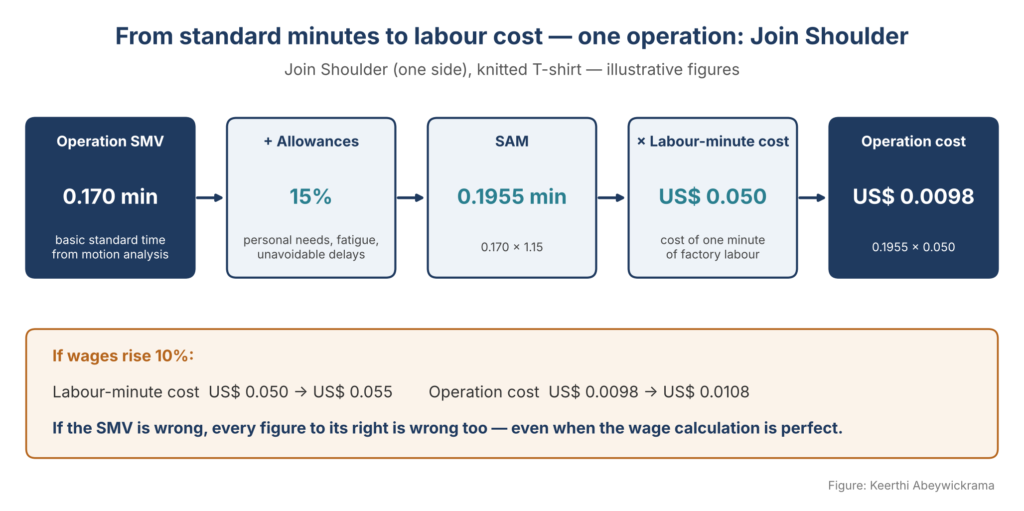
The following calculation illustrates how the resulting time can be used in labour costing. The figures are illustrative.
Illustrative calculation:
| Calculation | Illustrative value |
| Operation SMV | 0.170 minutes |
| Allowance | 15% |
| SAM | 0.1955 minutes |
| Labour-minute cost | US$ 0.050 |
| Operation labour cost | US$ 0.009775 |
The calculation is:
SAM = 0.170 × 1.15 = 0.1955
Labour Cost = 0.1955 × 0.050
= 0.009775
Now consider a simplified scenario in which the labour-minute cost increases by 10%, from 0.050 to 0.055.
0.1955 × 0.055 = 0.0107525
This demonstrates how a change in the cost of labour affects the operation’s cost, assuming the standard time and allowance remain unchanged.
This is an operation-level illustration only. It does not include a factory-efficiency adjustment, which a complete garment costing would also need.
But there is another important issue.
What happens if the original standard time is inaccurate?
If the time used in costing understates the actual standard time required by the defined method, the resulting labour cost will also be understated.
The wage calculation may be perfectly correct, but the garment price will still fail to reflect the full labour requirement.
One example from my own experience shows why accurate minutes are necessary, but not enough on their own. A typical ladies’ blouse with six or seven buttons may be decorated with a few extra buttons to bring newness to the next season. Costing them is straightforward, since the SMV per button and per buttonhole is easy to multiply. Yet a factory equipped with exactly the button-holing and button-attaching machines it normally needs can suddenly face a logistics nightmare.
When delivery schedules are tight, the extra work may demand more machines than its in-house backup, a machine layout that no longer fits, and additional operators — or airfreight to meet the shipment date. Accurate standard minutes must therefore be connected to capacity and resource planning, not only to the price.
What this means for different stakeholders
Industrial engineers
Standard minutes are not simply production targets. They are also important inputs into labour costing and production planning. Engineers should ensure that the method, operation breakdown, assumptions and allowances are documented sufficiently to allow the standard to be reviewed.
Buyers and merchandisers
When reviewing a garment costing sheet, it is useful to understand how the standard minutes were established. A negotiated price based on an unsupported or outdated standard time may not accurately reflect the labour required to manufacture the garment.
Factory owners and management
Reliable engineering data provides a stronger foundation for costing discussions with buyers. When a factory can explain how its operation times were established, it is better positioned to discuss labour requirements and the cost implications of wage changes using evidence rather than unsupported estimates.
Fair prices start with reliable minutes
Accurate standard minutes do not, by themselves, guarantee fair wages.
Fair wages depend on the actual wages paid, applicable labour standards and the commercial arrangements that enable factories to meet their obligations.
However, reliable work measurement is an important part of the calculation.
If the labour-minute cost is calculated correctly but the garment’s standard minutes are unreliable, the resulting labour cost will also be unreliable.
The relationship between work measurement, labour costing and wage compliance deserves greater attention from manufacturers, buyers and the wider apparel industry.
I would have loved to continue that work with Klaus. The questions we discussed — how to make labour costing reliable enough to carry a fair wage — are still the right ones for our industry. Improving reliable labour costing in apparel manufacturing will take its own time and course.
More reading:
LABOUR MINUTE COSTING A TOOL FOR ESTABLISHING LIVING WAGE FLOORS IN GARMENT FACTORIES by Klaus Hohenegger & Doug Miller for Fair Wear Foundation