

Table of Contents
Introduction: What is Open End Spinning
What is Open End Spinning?
Open end spinning is referred as the technique that creates yarn without using a spindle. In more general terms it is a method of producing yarn where the end of the yarn is kept free, or open, during twisting in this sense, the yarn is not twisted by rotating a package, as in ring spinning it is twisted by rotating its free end while single fibres are collected onto it. In ring spinning, drafting, twisting and winding happen in one continuous line. The yarn package is always connected to the drafting zone. In open end spinning, this connection is broken. In this system, twisting and winding are not done together. They are handled separately with the help of false twist. Because of this separation, open end spinning can run much faster at about 140000rpm, need less labour, and stop automatically when yarn breaks. For this reason, for coarser and medium yarns, open end spinning is not only an alternative method but is a more productive and economical system.
Open end spinning has a position that no other spinning system can match for mass production of coarser yarns. It is widely used for denim yarn, towels, bedsheets, home textiles, industrial yarns, and knitting yarns. It is also a major system for cotton, polyester cotton blends, and recycled fibres. This system provides work with high productivity one rotor machine can produce much more yarn per hour than a ring frame of the same size, and needs fewer workers to operate it.
Historical Context: From Ring Spinning to Break Spinning
The most important turning point in this story is the idea of break spinning, its early failure, and the later success of rotor spinning.
For the textile industry, break spinning was both a dream and a challenge. For many years, spinners wanted to make yarn without a spindle and traveller, because ring spinning is slow and needs many steps. Early inventors tried to break the fibre mass, collect fibres again, and twist them. Most early attempts failed because fibre control was poor, yarn was weak, and machines stopped again and again.
The main stages of open end spinning development started from 1937, where Berthelsen developed a relatively perfect open end then in 1949 Julius Meimbrg patented this newer technology then came Czech KS200 with 30,000 rpm in 1965 which was improved with G5/1 Reiterin 1967 and hence finally in 1975 came the first automated machine from Suessen equipped with Spincat and clean at opening the industrial rotor breakthrough. Thus then for mill owners, rotor spinning felt new better alternative but risky. It was faster, but yarn quality was different from ring yarn this is why mills first used rotor yarn only for coarse, low value products, and slowly moved to higher value products later. And hence in this way there came the breakthrough of break spinning in the textile arena.
Principle of Open End Spinning: How It Works
In open end spinning, twisting and winding are handled separately with the help of false twist. Real twist is still put into the yarn, but in a different way. The drafted fibre mass is thinned out until the fibres separate from each other. At that point, a break is created where the twist is inserted. In simple terms, the yarn end stays free during twisting, and it is this free end that keeps rotating. While it rotates, single fibres are collected onto it and twisted together to form the yarn. Because the yarn end is free, the twist does not have to travel through a whole package. It only has to twist the short length of fibres at the collection point. This is why rotor spinning can run at very high speed.
Main Parts of A Rotor Spinning Machine
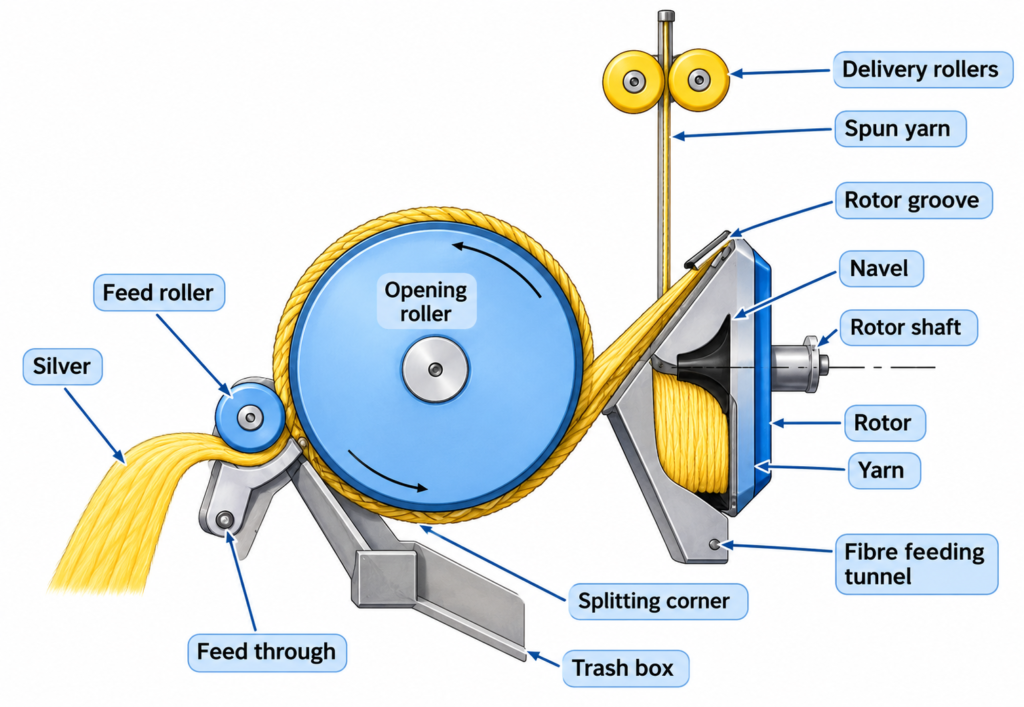
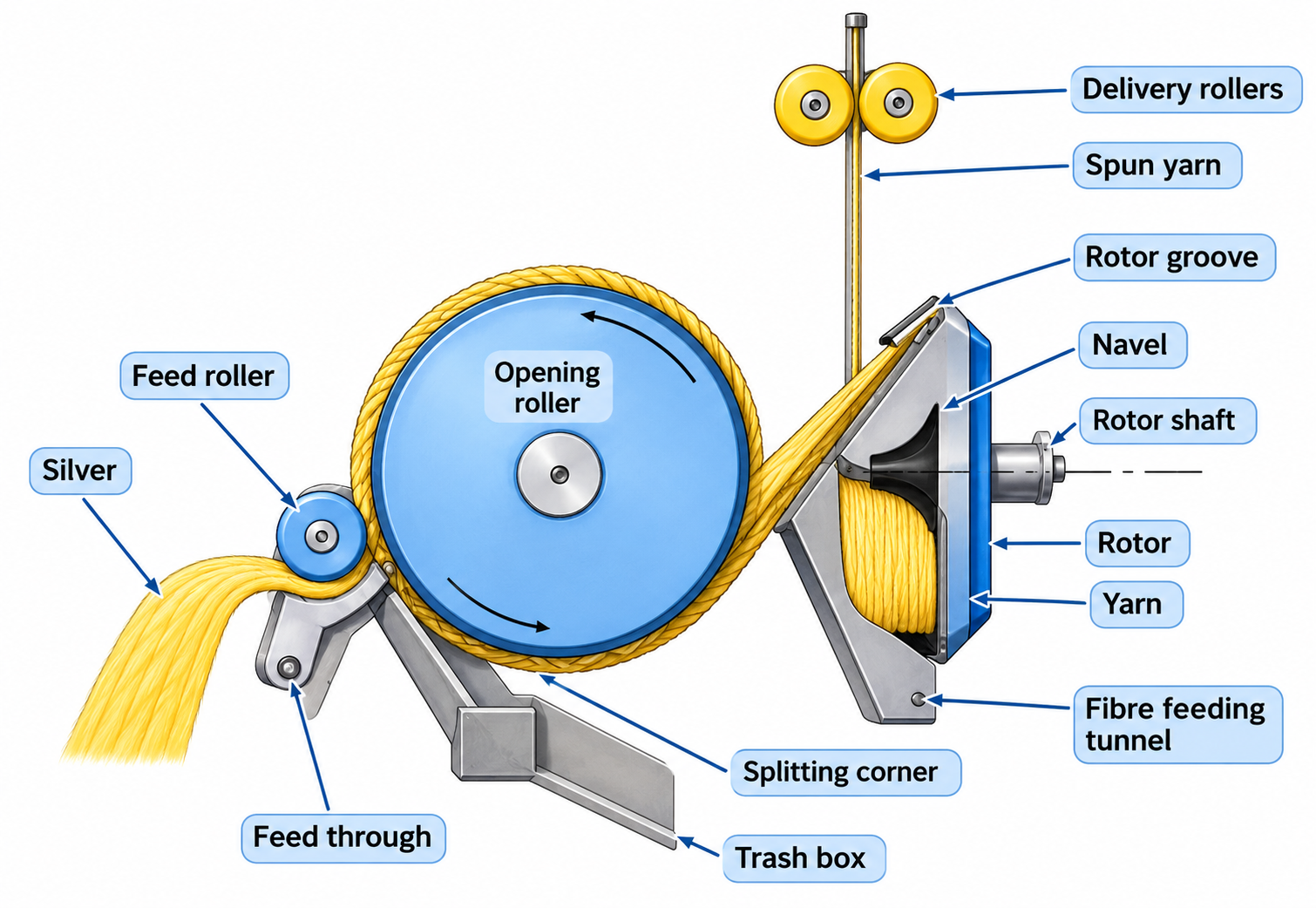
A rotor spinning machine has five main parts, and each part has a clear job.
- Feed Roller and Feed Table: The sliver is fed slowly into the machine. The feed roller holds the sliver and pushes it towards the opening roller.
- Opening Roller: This is a small roller covered with teeth or needles. It rotates at very high speed, around 6000 to 9000 rpm, and opens the sliver into single fibres. This is the most important part for yarn quality (Lawrence, 2010).
- Fibre Transport Tube: The opened fibres are carried by air flow from the opening roller to the rotor. Clean air flow is needed, otherwise fibres will get stuck or form neps.
- Rotor: This is a cup shaped part that rotates at very high speed. The rotor runs at extremely high speed, often above one lakh rpm in modern machines. Fibres are collected inside the rotor groove in a ring form. This ring of fibres is called the fibre ring.
- Doffer Tube and Winding Package: The yarn is pulled out from the centre of the rotor through the doffer tube, and then wound onto a large package. The package is much bigger than a ring cop, so fewer doffing breaks are needed.
Yarn Formation: Opening, Transport, Collection And Twisting
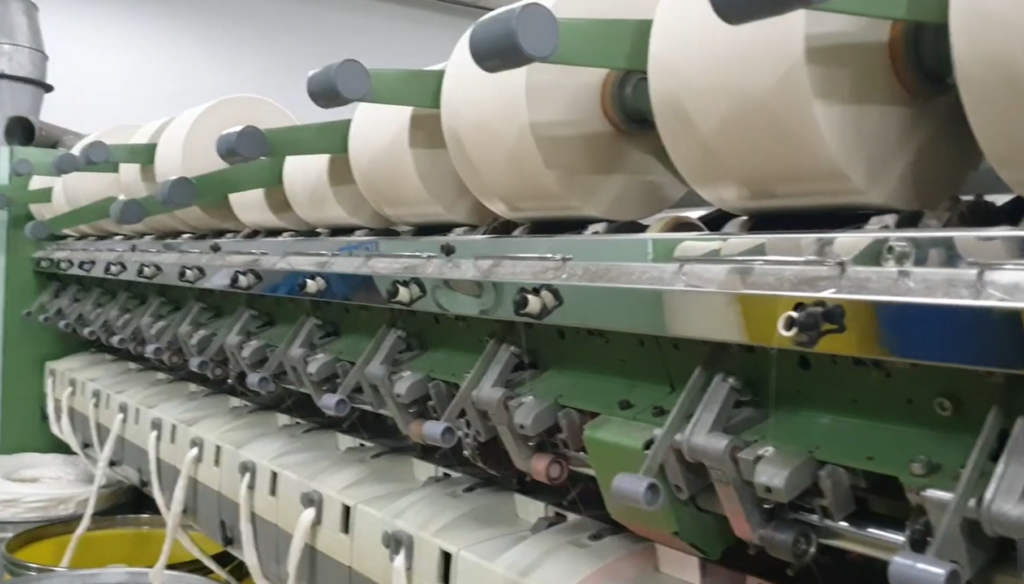
Yarn formation in open end spinning happens in four steps.
- Opening: The sliver is opened into single fibres by the opening roller. If the opening is poor, yarn will have thick places and neps.
- Transport: The single fibres travel through the transport tube to the rotor. Air speed and tube design decide whether fibres arrive in a straight and even way.
- Collection: Inside the rotor, fibres slide to the rotor groove and form a fibre ring. The fineness of this ring decides the evenness of the yarn.
- Twisting and take up. The free end of the yarn rotates with the rotor. As the yarn is pulled out, the fibres in the ring are twisted together and become yarn. The twist runs back to the fibre ring, and new fibres keep joining it. This continuous joining is what keeps the yarn forming without break.
Comparison: Open End Spinning Vs Ring Spinning
Faced with cost pressure and labour shortage, mills are now choosing between ring and open-end systems. Ring Spinning comes with great yarn quality specially for fine counts, small package sizes, high labour need low automation and with low production speed. Whereas Open End Spinning comes with high production speed, good yarn quality for coarse and medium counts, large package size, low labour need and high-end automation. In simple terms, ring yarn is softer, stronger, and better for fine fabrics. Open end yarn is bulkier, more even in short lengths, and better for denim and home textiles. Ring yarn has better hand feel, open end yarn has better abrasion resistance and pilling resistance. For a mill, the choice is not only about quality, it is about product. If the mill makes fine shirting, it will choose ring. If it makes denim or towels, it will choose open end.
Process Parameters That Control Yarn Quality
Yarn quality in open end spinning depends on five main parameters.
- Rotor Speed: Higher rotor speed gives more production and more twist, but also more yarn breakage and more wear. If rotor speed is too high, fibre damage increases.
- Opening Roller Speed: Higher opening roller speed gives better fibre separation, but also more fibre breakage and more dust. It must be balanced with fibre type.
- Twist Multiplier: Twist decides yarn strength and elongation. Low twist gives soft yarn but low strength. High twist gives strong yarn but harsh feel and low production.
- Rotor Diameter: Small rotor is good for fine yarn, large rotor is good for coarse yarn. Wrong rotor size causes more yarn faults.
- Take Up Speed and Draft: Take up speed decides production rate. Draft decides yarn count. If the draft is not stable, yarn count will vary.
Open end spinning is thus a system of balance. One parameter cannot be changed alone. Changing rotor speed without changing twist or opening speed will create new problems.
Modern Developments In Open End Spinning
Modern open end machines are very different from the early machines.
First, automation. Modern machines have automatic piecing. When yarn breaks, the machine itself joins the yarn without stopping the whole machine. This reduces labour and increases efficiency. Second, quality monitoring. Modern machines have sensors that check yarn evenness, thick places, thin places, and neps in real time. If a fault is found, that section is cut out automatically. Third, foreign fibre removal. Sensors can detect white polypropylene, coloured fibres, and other foreign material and remove them before they become yarn.
This is very important for denim and export quality yarn. Fourth, energy saving. New rotors, drives, and suction systems use less energy per kg of yarn. This is important because rotor spinning uses more energy than ring spinning. Fifth, recycled fibres. Open end spinning is now used more for recycled cotton and recycled polyester, because it can handle short fibres better than ring spinning. This matches the global push for sustainability.
Advantages Of Open End Spinning
Open end spinning today has a strong position in the market. The following points explain why mills prefer it for many products.
- High Productivity: Open end machines run at very high delivery speed, up to 200 meters per minute, much higher than ring frames. One operator can look after a larger number of rotor positions than ring spindles.
- Large Package and Less Doffing: Open end packages are large, up to 4 to 5 kg. This means fewer package changes, less stoppage, and better efficiency in weaving and knitting.
- Lower Labour and Automation: Automatic piecing, automatic doffing, and automatic fault removal reduce dependence on skilled labour. This is a big advantage in countries with labour shortage and rising wages.
- Better Yarn Evenness and Appearance: Open end yarn has better short term evenness, less hairiness in some cases, and better abrasion resistance. For denim, towels, and home textiles, this gives better fabric performance.
- Suitability for Waste and Recycled Fibres: Open end spinning can use short fibres, comber noil, and recycled fibres more easily than ring spinning.
Disadvantages And Limitations of Open End Spinning
Even with these advantages, open end spinning faces serious problems that limit its growth.
- Limitation in Fine Counts: Open end spinning is mainly suitable for coarse to medium counts, up to 30s Ne. It is very difficult to make fine yarns like 60s or 80s Ne with good quality. Ring spinning is still better for fine yarns.
- Lower Yarn Strength: Compared to ring yarn of the same count, open end yarn usually shows lower strength. This is because fibre arrangement is less parallel and twist is less uniform. This limits its use in high strength fabrics.
- Higher Energy Consumption: Rotor spinning needs high speed rotors, opening rollers, and suction fans. This uses more energy per kg than ring spinning. For mills, energy cost is a major concern.
- Fibre Damage and Dust: The opening roller can damage fibres and create dust and micro dust. This affects yarn quality, machine cleanliness, and worker health if suction is not good.
- High Maintenance and Machine Cost: Rotors, opening rollers, and bearings need regular cleaning and replacement. Machine cost is high, and spare parts are costly. In simple terms, when an open end machine stops, the loss of production is higher than a ring frame.
Open end spinning gives the mill speed and automation, but ring spinning gives the mill fineness and strength. The mill that understands this difference can choose the right system for the right product.
Multi-Viewpoint Discussion: Different Realities
- Viewpoint of Spinners and Mill Owners: For them, open end spinning is a cost problem and a productivity solution. High production and low labour save money, but high energy and maintenance increase cost. They need machines that run without breakage.
- Viewpoint of Weavers and Knitters: For them, open end yarn is a running performance solution. Large packages mean fewer knots, fewer stops, and better loom efficiency. They are ready to accept slightly lower strength if the yarn runs well.
- Viewpoint of Fabric Buyers and Brands: For brands, open end yarn is a product choice. For denim, they want the faded look and bulk that open end yarn gives. For fine shirts, they still want ring yarn.
- Viewpoint of Workers: For workers, open end spinning changes jobs. One worker can handle many rotors, so fewer workers are needed. But the work is more technical, cleaning, monitoring, and machine setting, not manual piecing.
- Viewpoint of Environment and Sustainability: Open end spinning uses more energy, but it also uses more recycled fibres and produces less waste in winding because of large packages. Mills must balance energy use with recycling benefit.
- Viewpoint of Technology and Engineering: For technocrats, open end spinning creates new engineering demand: high speed rotor design, air flow modelling, sensor based quality control, and automation. The textile engineer of the future must understand both mechanics and electronics along with textiles.
Conclusion and Future Outlook
Open end spinning has moved from an experimental idea to a major spinning system for coarse and medium yarns. First, it was seen as a cheap alternative to ring spinning. Then, it became the main system for denim and home textiles. Now, with automation, quality monitoring, and recycling, it is becoming a smart spinning system. And now with traceability of each step brands no longer ask only: Is the yarn strong? They ask: Is it even, Is it clean, Is it sustainable, and can it be delivered fast? Open end spinning can answer these questions for many products, because it has speed, large packages, automation, and suitability for recycled fibres. But it will fail if it does not solve its internal weaknesses: fine count limitation, lower strength, high energy use, and fibre damage. Hence to match the ring spinning quality and trust it has to move a long way towards automation and quality monitoring along with more development in the inner technology.
References:
- Oxtoby, E. Spun Yarn Technology. Butterworths, 1987.
- Salhotra, K. R. Spinning of Man Made Fibres and Blends on Cotton System. Textile Association, 1989.
- Lawrence, C. A. Advances in Yarn Spinning Technology. Woodhead Publishing, 2010.
- https://uptti.ac.in/classroom-content/data/The_Rieter_Manual_of_Spinning_vol._6_1926-v3_83556_Original__English__83556.pdf , Klein, W. Manual of Textile Technology, Volume 4: A Practical Guide to Opening and Carding. The Textile Institute, 1987.
- Klein, W. Manual of Textile Technology, Volume 5: A Practical Guide to Rotor Spinning. The Textile Institute, 1993, https://sitaramspinners.com/history-of-open-end-spinning-open-end-spinning-process-flow-chart/





Leave a Reply