
Introduction
Why do fabric problems often surface only after cutting? A roll can pass a visual check with acceptable GSM and shade, then twist after the first wash because no one measured skewness. Another lot can show good stretch recovery in the lab, but the test used a low-power knit method that does not match a high-stretch spandex fabric. Both cases point to the same problem: incoming fabric inspection for nylon/spandex knits cannot follow a woven fabric script.
The job is to catch the problem before the cutting table. Once the fabric is cut, the material, cutting, and sewing costs are already committed. This article covers what to check on the roll, what to test before cutting, and how to turn the results into a release decision.
1. Why Nylon/Spandex Knits Are Different
Nylon/spandex knits are loop structures that stretch differently in length and width. Their behavior after washing depends on yarn, loop density, heat history, and finish. They can shrink, skew, curl at the edge, or lose recovery. A woven inspection protocol can check width and visible defects, but it does not measure these elastic failure modes. GSM tells you mass per unit area; it does not predict stretch, recovery, skewness, or color fastness.
Edge curl is not universal: it depends on structure, density, and finishing. Circular knits can skew because of yarn twist, construction, finishing, and relaxation after washing. Not every circular knit will skew, but the risk is real. These differences matter because a lot that looks flat on the roll can still fail after garment washing.
2. Fabric Inspection – What to Check During Roll Inspection
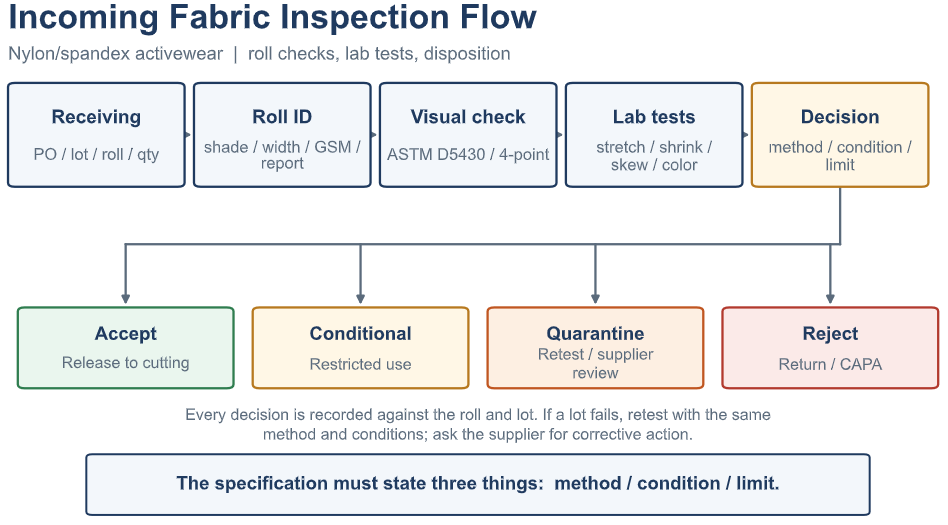
When a roll arrives, start with identity. Check the purchase order, lot number, roll number, quantity, packing condition, and the mill’s test report. A fabric roll that cannot be traced to a lot should be isolated.
Check shade against the approved standard under the agreed light source, commonly D65 or TL84. Record roll-to-roll and lot-to-lot variation, and state the buyer’s color-difference limit (commonly ΔE ≤ 1.0 or grey scale grade ≥ 4). Do not mix rolls outside that limit in one cutting lay.
Measure usable width at three points per roll and record the average, minimum, and maximum. Record the buyer’s width tolerance of ±1.5 cm to ±2 cm. Width variation within a roll can cost more in cutting than a uniformly narrow roll.
Check GSM with ASTM D3776. Record the sample area, sample count, conditioning, and the buyer’s tolerance (commonly ±5%). GSM does not predict stretch or recovery, but it confirms the ordered construction.
Inspect the surface under the agreed light source. ASTM D5430 covers visual inspection and grading; the 4-point system is a common option, not the whole standard. Record defect type, length, and position. Under 4-point, defects score 1 to 4 points by length, with a maximum of 4 points per linear yard. Convert to points per 100 yd² with this formula: (total points × 3,600) ÷ (width in inches × yards inspected). The buyer’s limit is commonly 20–40 points/100 yd²; it is buyer-defined, not an ASTM pass mark.
Check edge curl, slack or tight edges, creases, oil marks, and splices. Record splice count and position. These details affect cutting yield and can reveal problems a defect count misses.
For lot acceptance, use ANSI/ASQ Z1.4 or ISO 2859-1. The sample size comes from the table based on lot size, inspection level (commonly General Level II), and the agreed AQL (commonly 2.5 for major defects); it is not a fixed 10 percent. Record the Ac/Re numbers. AQL is not a defect percentage, and the 4-point score is not an AQL defect rate.
Finally, record roll-to-roll variation. A lot can pass each individual check and still be unusable if the rolls differ enough to change the cutting plan.
Related Post: Nylon-Spandex Garment Care Protocol: ISO 6330 | www.foralltex.com
3. Pre-Cutting Laboratory Tests
Lab tests answer what the roll cannot. Each test must state the standard and edition, test conditions, sample direction, results, and judgment criteria.
Stretch and recovery: match the method to fabric power. For high-stretch nylon/spandex knits, use ASTM D4964 or ISO 20932-1. For low-power knits, use ASTM D2594. ASTM D3107 is for woven fabrics made from stretch yarns; do not apply it to nylon/spandex knits unless the buyer explicitly requires it. Record direction, gauge length, load or extension, cycle count, and growth/recovery values. The buyer’s limits are growth ≤ 5% and recovery ≥ 90%.
Wash dimensional change: use ISO 6330 with ISO 5077, or AATCC 135. Record the wash program, temperature, detergent, ballast, drying method, number of cycles, and conditioning. Report warp and weft separately. The buyer’s limits are ±3% to ±5% for both warp and weft.
Skewness: use AATCC 179 for skewness change after washing, or ASTM D3882 for bow and skew. This is especially relevant for circular knits. Record pre-wash and post-wash measurements, direction, measurement length, and change rate. The buyer’s limit is commonly ≤ 3% to 5% skewness change.
Colorfastness covers several exposures. Wash fastness: ISO 105-C06 or AATCC 61. Perspiration: ISO 105-E04 (acid and alkaline) or AATCC 15 (acid only). Light: ISO 105-B02. Chlorinated water: ISO 105-E03 or AATCC TM162 when the product contacts pool water. Report color change and staining separately, and name the adjacent fibre. The buyer’s minimum grade is commonly Grade 4 for sportswear.
Pilling and abrasion: these are different failure modes. ISO 12945-2 or ASTM D4970 covers surface pilling; ISO 12947-2 covers abrasion and specimen breakdown. ISO 12947-2 uses 9 kPa for apparel and 12 kPa for upholstery. For many knits, the practical endpoint is the first yarn break; confirm the endpoint rule in the buyer’s specification. Do not apply a home-textile rub count to apparel. For loose structures, fleece, or terry, use ISO 12945-1 or ASTM D3512 instead of Martindale. Record cycles, endpoint rule, and grade. The buyer’s limits are commonly pilling grade ≥ 3–4; for abrasion, the endpoint is often the first yarn break rather than a fixed cycle count.
Condition specimens before testing per ASTM D1776 or ISO 139. If a third-party report is used, check that the lab is accredited to ISO/IEC 17025 for the method and that the method is inside the accredited scope.
4. Judgment and Disposition
Turn the results into one of four decisions: accept, conditional accept, quarantine, or reject. Accept only when the roll checks and lab results meet the agreed specification. Conditional accept is for a defined, limited use, such as a darker shade kept out of the main lot. Quarantine holds the lot until a retest or supplier explanation. Reject keeps the lot out of cutting.
The specification must state the method, the condition, and the limit. Without all three, the factory has no basis for acceptance. If a lot fails, retest with the same method and conditions. Do not switch methods to get a passing result. Trace the decision to the roll and lot numbers, record the decision-maker and date, and ask the supplier for a corrective action. A quarantined lot is not a warehouse problem; it is a decision waiting for evidence.
The 4-point system grades visible defects; AQL is a lot-acceptance plan. Use both, but do not convert points into an AQL defect rate.
5. One-Page Fabric Inspection Checklist
Table 1. Incoming Fabric inspection checklist for nylon/spandex knits.
Common values are shown; confirm them against the buyer’s written specification before printing.
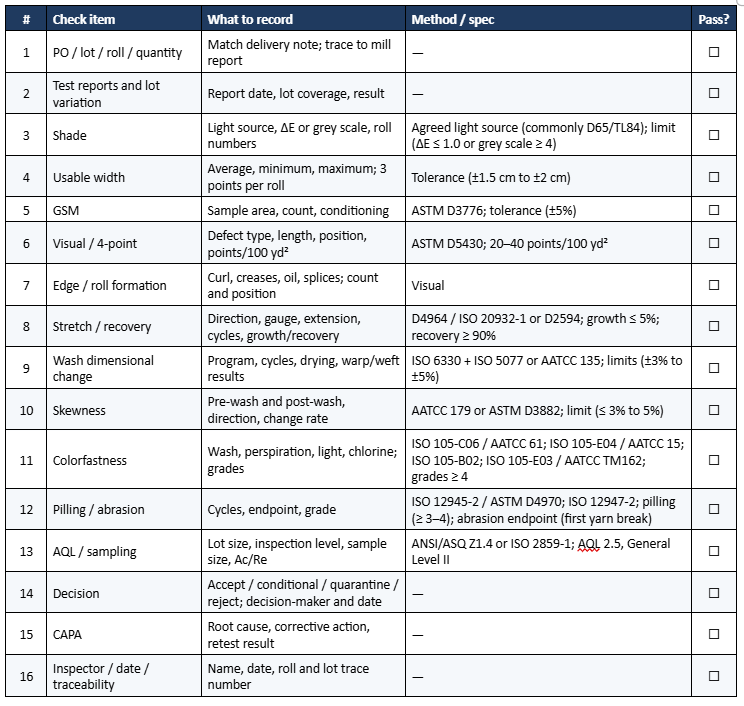
The purchase order is the contract. If it says “color must match” and “elasticity must be good” without a method, the factory cannot accept or reject a lot on equal terms. Write the method, the condition, and the limit into the specification. Then the incoming check becomes a decision, not an opinion.
Conclusion:
The above checklist described the fabric inspection and testing standards for garment factories. The lab testing processes ensure acceptable fabric quality for active wear manufacturing. For maintaining quality standards of the activewear apparels, factories must consider the process of incoming fabric inspection.