
When a brand sends a sock factory a tech pack, the pages are often strong on color, logo artwork and the length of the leg. The heel and the toe are frequently described with a single word — “seamless,” “reinforced,” “Y-heel” — or not described at all. Those two zones take most of the walking load. They are also where constructions that look similar on a flat sketch behave very differently on the foot, and cost different amounts to knit and close.
This article is a practical map of the heel and toe constructions a merchandiser is likely to meet on a circular sock-knitting machine. It is written for product developers and garment technicians who brief mills, not as a full tour of how a sock is made from yarn to carton. The aim is to put enough language on the purchase order that the sample you approve is the construction you later receive in bulk.
Start with a basic distinction: a formed heel, or a tube
A large share of everyday and sports socks are knitted as a tube on a circular machine. The cuff, leg, heel, foot and toe can be produced in one pass, but “in one pass” does not automatically mean the sock has a shaped heel.
A reciprocated heel is formed when the machine stops going around and knits back and forth, adding and reducing needles, to build a cup that sits under the heel. You can usually see gore lines — short fashioning marks — at the sides of the heel. That cup is what keeps a crew or dress sock from twisting around the ankle.
A tube sock has little or no reciprocated heel. The tube may have a reinforced patch, a denser knit, a different colored yarn, or simply a printed or knitted marker where the heel should sit. Tube constructions are common in some athletic and team styles. They are not a defect, but they fit differently. If the brief says “crew sock” and is silent on the heel, one mill may program a reciprocated heel and another may knit a marked tube.
If you care about the fit, write one of these on the tech pack: “reciprocated heel,” “tube, no reciprocated heel,” or “tube with heel reinforcement only.” Do not rely on a side-on sketch alone.
Reciprocated heels: Y-heel, round heel, and depth
Among reciprocated heels, two shapes come up most often in commercial specs.
A Y-heel has a characteristic Y-shaped gore line. It is a common choice for dress and fine-gauge everyday socks, because the cup is defined and the inside can be kept relatively smooth.
A round heel (also called a pouch or pocket heel) forms a more rounded cup. It is often used where the designer wants a deeper seat, for example in some sports and heavier constructions.
The name is not a complete specification. Two Y-heels can still differ in depth (how far the cup extends under the foot), in width, and in whether the heel uses the body yarn or a reinforcement yarn. “High heel” or “deep heel” is worth stating when the sock is a no-show or a low-cut style, because a shallow cup is a common reason the sock walks out of the shoe.
Left and right (anatomical) heels are a further option. The machine knits a mirrored pair rather than a symmetrical sock that can be worn on either foot. This can improve fit, but it also changes pairing, packing and replacement. If you want L/R pairs, say so, and say whether a mixed leftover size of “left only” is acceptable in a bulk shipment.
Reinforcement is not the same as shape
“Reinforced heel and toe” describes the yarn or the stitch density in those zones, not the shape of the heel and not the method used to close the toe. A mill can reinforce a reciprocated heel, a tube heel patch, or both.
Reinforcement is usually a nylon or polyester yarn knitted in with the body yarn, or a denser stitch, in the high-wear areas. It is one of the more cost-effective ways to improve abrasion life on a cotton or cotton-blend sock. If you specify it, name the zones (heel only, heel and toe, or a defined wear patch) and whether the reinforcement yarn may show as a slight sheen or a slightly different shade. That last point avoids a surprise on a light-colored dress sock.
How the toe is closed, and what “seamless toe” actually means
After the tube is knitted, the toe is still an opening. Closing it is a separate decision, and it is the place where catalog language is most often stretched.
Hand linking (loop-to-loop, sometimes called hand looping) joins each knitted loop to the matching loop on the other side of the opening. It is slow and usually reserved for finer or higher-priced work. The join is flat and hard to feel with a finger inside the sock.
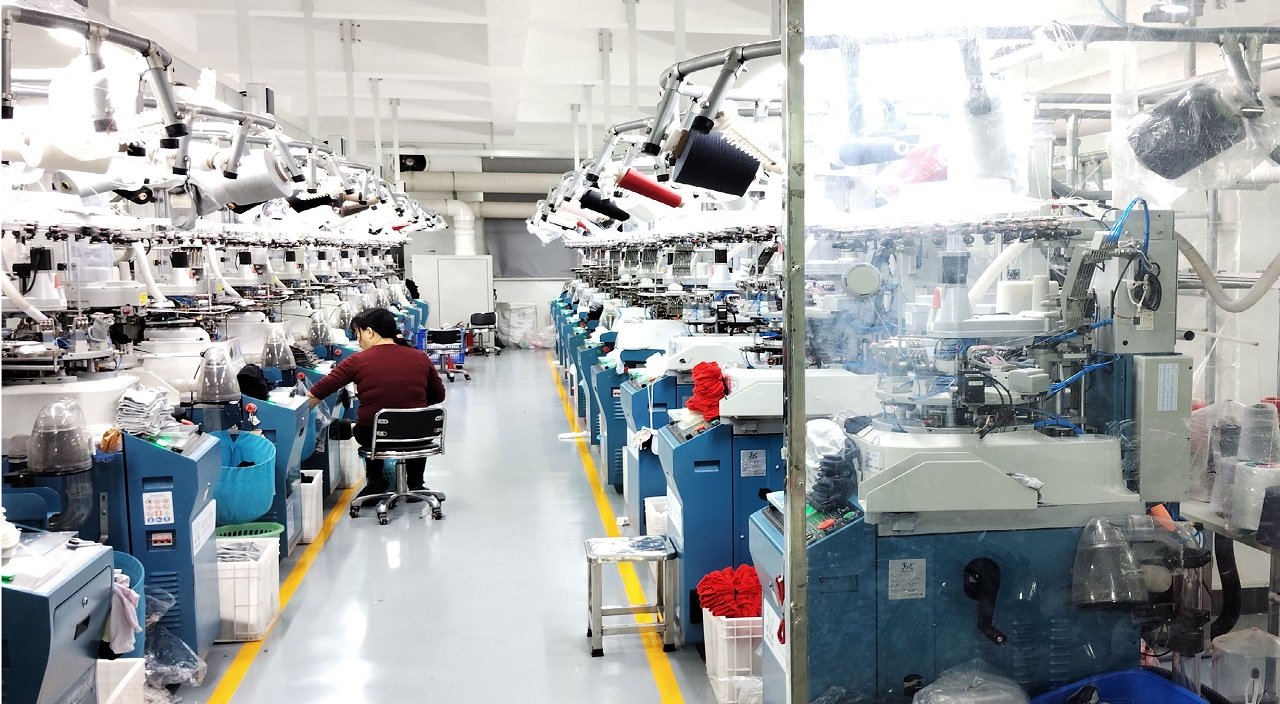
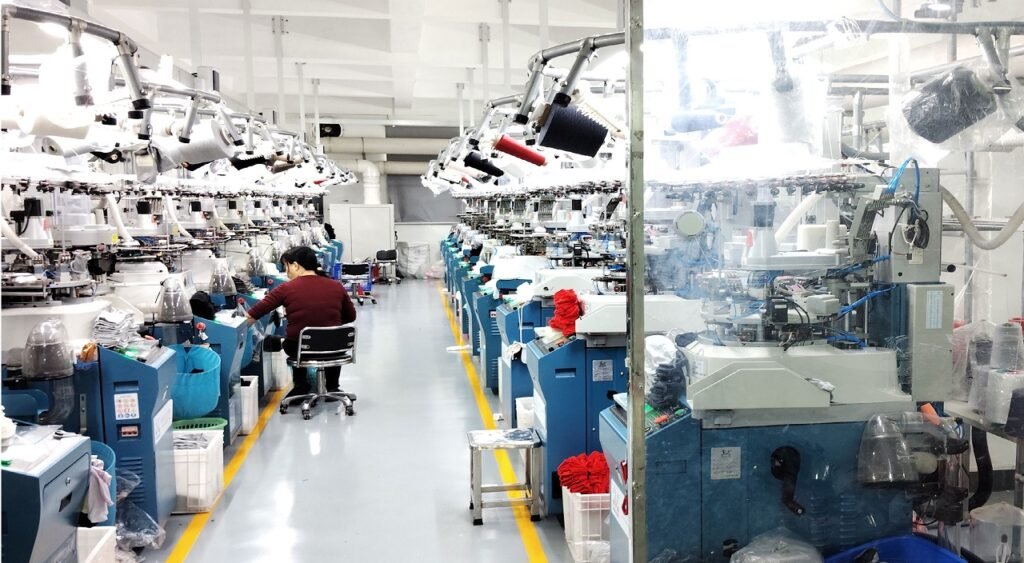
Automatic linking does the same kind of point-to-point join on a device rather than by hand. On many modern sock machines, including the ones in the factory where I work, the knitted sock is transferred to a linking unit on the same machine. Each needle is matched to the corresponding needle, the toe is joined, and the sock is turned. The join is intended to be flat enough that it does not leave a ridge across the toes. In our shop that closing step takes about a minute and a half, and the next sock is already being knitted while it happens. Buyers often see this described as a “seamless toe” or “invisible join.”
Overlock (serger) closing sews the opening with an overedge stitch. It is fast. It also leaves a ridge. Some buyers accept that ridge on a thick sports sock and reject it on a dress sock.
Rosso closing uses a specialized toe-seaming machine. It is widely used in volume hosiery production. The join is generally cleaner than a basic overlock, but it is still a seamed join, not a loop-to-loop link, and a ridge can still be felt on finer gauges.
“Seamless toe” in a catalog should therefore be treated as a claim to be verified, not as a standard term. It usually means a linked, point-to-point join. It does not mean the sock has no toe at all, and it is not the same as a true knitted-closed toe, in which the machine finishes the toe without a later joining step. If the absence of a ridge matters to you — and it usually does for dress socks, fine-gauge cotton, and some running socks — write “linked toe (point-to-point / loop-to-loop), no overlock or Rosso seam” on the spec, and check the sample with a finger from the inside.
What to put on the tech pack or purchase order
A short construction block is enough, if it is specific. For example:
- Heel: reciprocated Y-heel / reciprocated round heel / tube with reinforcement only. Depth: standard / deep. Reinforcement yarn: yes or no, and in which zones. Pairing: symmetrical or left/right.
- Toe: hand-linked / automatic linked (point-to-point) / Rosso / overlock. If you want a flat join, say “linked toe, no ridge,” and ask for a inside-out detail photo of the bulk method, not only of a hand-finished sample.
- Gauge and needle count: these affect how visible any join will be. A ridge that disappears in a heavy terry sports sock will be obvious in a fine-gauge dress sock.
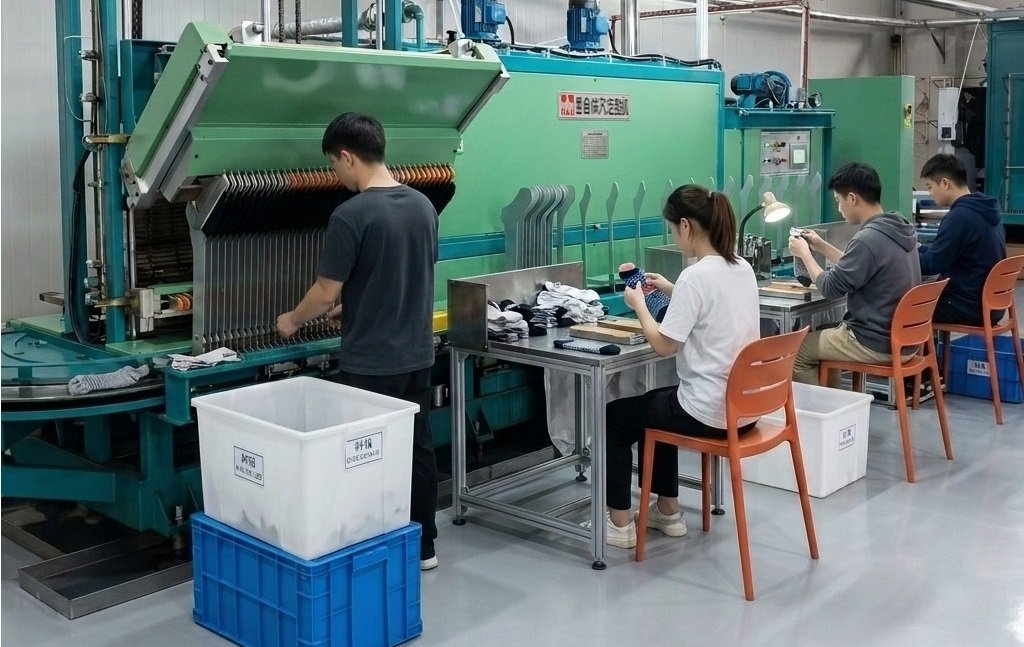
- Boarding (heat-setting) does not change the heel type, but it does set the final outline. If you approve a boarded sample, bulk should be boarded the same way, or the heel cup and toe shape will look different in the bag.
When you receive the sample, turn it inside out. Look at the gore lines of the heel and run a finger across the toe join. Compare that join with the method named on the order. If the sample was hand-finished “to look clean” and the bulk will be overlocked, you have not yet approved the production method.
Why this belongs in the brief, not only in a later quality check
Heel and toe constructions are poor candidates for fixing after the first bulk shipment. Changing a tube into a reciprocated heel is a different machine program. Changing an overlock toe to a linked toe is a different process and a different cost. Both can also change the size and the way the sock sits in the shoe.
That is why these choices should be written down at development, confirmed on the pre-production sample, and repeated in the bulk order, in the same words. A clean pair price with a vague “seamless” line next to it is not a complete construction brief.
This article is contributed by Jim Xu from JLSockFactory.