


I am working in a garment factory that makes ladies fashion, semi-formal basic shirts. I am new to garment industry and am working as an industrial engineer. I am facing difficulty in making operation bulletin and preparing the operation sequence. Can you please provide me an operation bulletin for ladies basic shirts, semi-formal shirts, and tunic?
How to that?
You have emphasized on the sequencing of the operations in operation bulletin. I will focus on that part of this article.
You need to study the garment construction. If you have access to the sampling room in your factory, take help from the sampling team to learn the product construction for the upcoming styles. If the style is already running on the production floor, spend time on the floor and follow the sequence of operations performed by the operators to construct the complete garment.
Operation sequencing is part of making an operation bulletin. Preparation of an operation bulletin involved two activities-
- Preparation of the operation breakdown – I mean making the list of all operations involved in making the product.
- Estimating SMV of garment operations.
Operation sequencing method
Follow the below steps to make the OB yourself.
- Pick one sample garment
- Identify garment components. Like in a formal shirt garment components are – Collar, Cuff, front, back, and chest pocket.
- Prepare a list of operations in the sample garment component-wise. In case you unable to identify components, just list down operations.
- Group operations by garment components – if you find difficulty understanding any seam /operations, discuss with the line supervisor or sampling master. They can guide you in understanding the garment construction.
- Then think of the logical sequence of making or stitching the garment. Visualize how operators will make the sample garment. If there is more than one operation in a seam – what operation should come prior to another? If you need, open the garment seam and look inside how the garment components are joined together and possible sequence of operations inside the seam.
- Now place all operations in a sequence as per your understanding (don’t worry if something goes wrong). You can later change the operation sequence by observing the process sequence on the shop floor.
You are done. See the following example of operation sequencing.
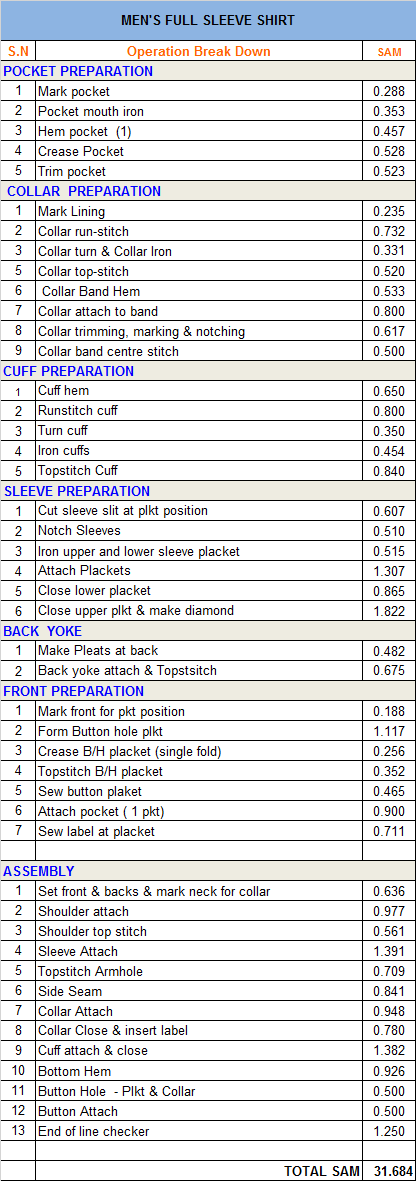 |
| Operation Sequence of Shirt Making |
Why correct sequencing?
An operation bulletin with correct operation sequence helps on the following
– Understanding garment construction
– Production line setup with correct operation flow
– Easy to display line balancing
– Managing bottleneck in the production line







Leave a Reply