
Abstract
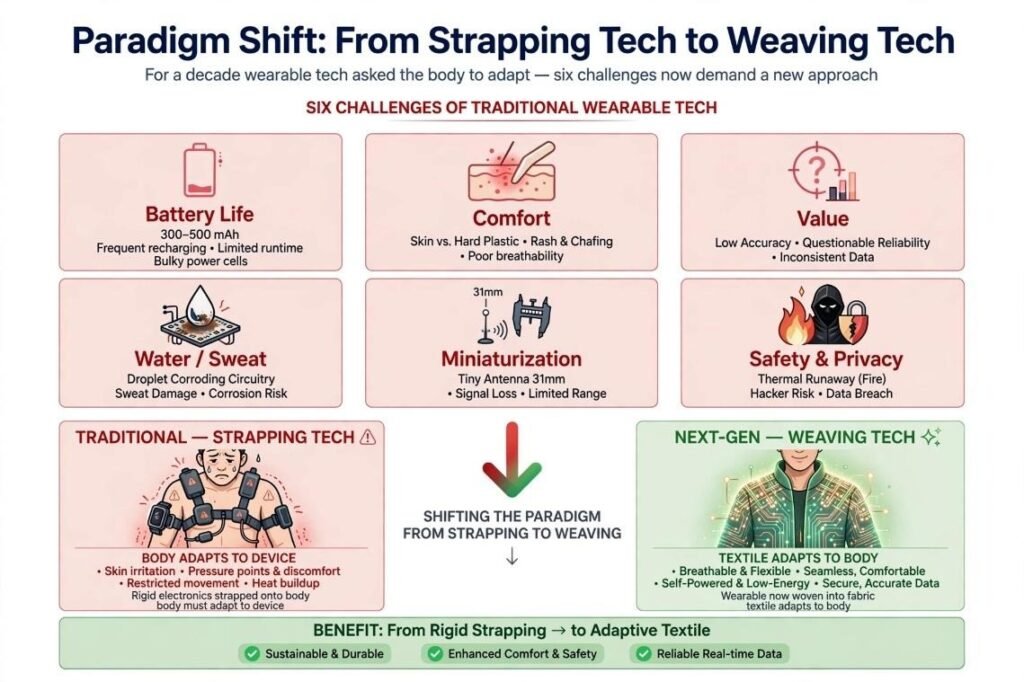
For a decade, wearable technology asked the human body to adapt to it — to charge it, to endure its heat, its weight, its constant buzz. This paper revisits the six fundamental challenges to wearable adoption identified in 2017 — battery life, comfort, value, water/sweat, miniaturization, and safety — and analyzes why gadget-based architectures fail to resolve them at the physics level. We propose that the paradigm must shift from strapping technology to the body, to weaving it into the body’s natural cover, textiles.
Introduction
Remember that dark road? Both hands full. A bag on the left, a bag on the right. And still, you had to somehow hold that big, fat, heavy torch. Fingers paining. Arms aching. Heart just trying to get home.
That small pain — of having no free hand when you needed one the most — is what shaped today’s Wearable smart technology .
Problem Statement on Wearable Technology
The Six Persistent Barriers (Kalia, 2017)
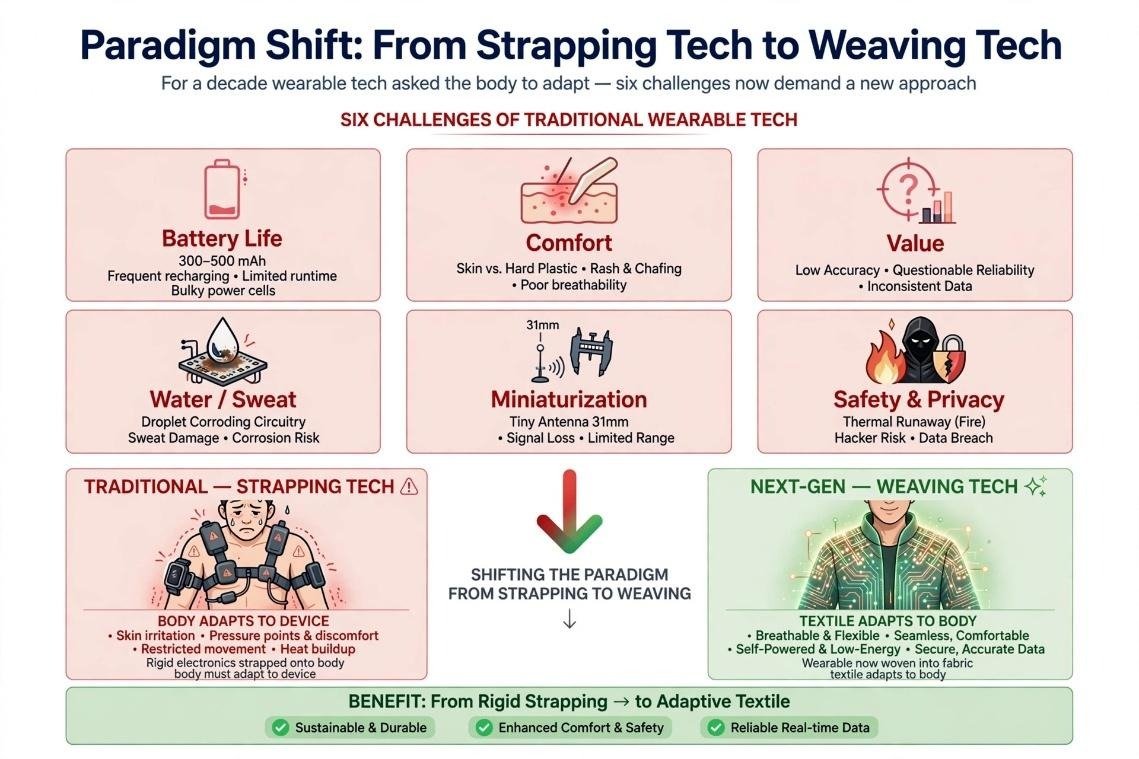
In 2017, six challenges were identified that continue to haunt wearable devices. These are physics problems, not software bugs. Gadgets can only manage them. Textiles can solve them.
- Battery Life- The first challenge is battery life. A typical smartwatch holds only 300-500 mAh, about 1.1 Wh of energy. Continuous sensing drains it in 18 to 24 hours. This forces manufacturers into painful compromises — as UCLA found, Bluetooth Low Energy consumes less than 3% of the energy of Wi-Fi, so they must use it. Sony even used E-Ink with 0 mW static power just to achieve 3 days of life. The human consequence is charging anxiety and user fatigue.
- Comfort: The second is comfort. The elastic modulus of human skin is only 0.5-2 MPa, while the plastic housing of a gadget is 2.3 GPa — a thousand times stiffer. This mismatch creates pressure and rashes. Under plastic, skin temperature rises by 1.5-2.3°C within 60 minutes. This is not theoretical — it led to the Fitbit Force recall in 2014.
- Value: As Astro Teller, who led Google Glass, said, “There is no point in having it on your body unless you can give people something they really could not get otherwise.” Today, wrist-based PPG shows a 5-12% error compared to ECG during motion, which is not medical-grade. As a result, 32% of users abandon wearables within 6 months.
- Water and Sweat: Sweat is not water. It is a 0.9% NaCl electrolyte with a pH of 4.5-7.0. It corrodes charging pins at a rate of 0.3-0.8 mm per year and causes short circuits. To survive, devices require IP67 protection and ENIG gold plating of 50-100 µin Au. Unsealed devices fail the ASTM B117 salt spray test in less than 96 hours.
- Miniaturization: Physics does not shrink. A 2.4 GHz antenna requires 31 mm of space. Inside a 40 mm watch placed directly on skin, antenna efficiency drops from 70% to less than 25%, and SAR rises to ∼0.8 W/kg. Brands are forced to use expensive MID/LDS technology to embed antennas, which reduces manufacturing yield to 85-90% and increases cost by 3x.
- Safety and Privacy: A small 500 mAh cell stores 6.8 kJ of energy — thermal runaway can reach over 600°C in 5 seconds. On the data side, an HP audit found that 70% of wearables transmit data without encryption, and BLE can be intercepted within 10 meters.
Inference: Gadgets fight physics. They add more sealing, more gold, more low-power compromises. Smart textiles solve these problems at the fiber level.
Proposed Solution: Why We Prefer Textiles
Wearable technology wanted to be invisible and empathetic. Gadgets couldn’t get there. So we stopped strapping tech to the body. We started weaving it into textiles.
- Enhanced Comfort and Flexibility: Comfort is Survival: Fabrics move naturally with our body. Conductive fibers breathe like cotton and bend like silk. Textile modulus matches skin, resolving the comfort challenge at the material level, enabling true 24-hour continuous monitoring.
- Discreet and Stylish Design: Style is Dignity, The best technology disappears to keep the style up. Levi’s and Google Project Jacquard proved this in 2017 — conductive yarns woven at loom scale, control via a brush of the sleeve, invisible to the observer.
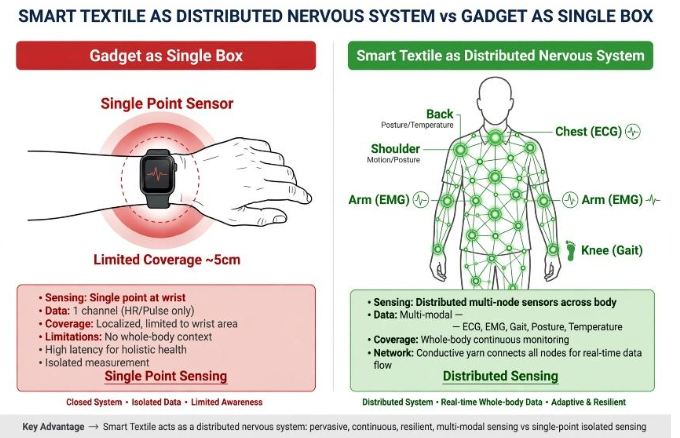
- Better Data Accuracy: A wristband measures from one spot. Garments cover the chest, back, and shoulders. Hexoskin (validated in over 275 peer-reviewed studies) can catch health changes hours before hospital vitals change. Smart bandages can sense infection, and Athos can map muscle activity in real time.
- Distributed Technology: A smart garment spreads sensors like a nervous system — knee for gait, sternum for rhythm — resolving miniaturization. Boston Dynamics and Tesla Optimus now use textile sensor skins for proprioception. Taiwan’s ITRI has demonstrated stretchable interconnects with >100% elongation.
- Energy Harvesting: Instead of storing, textiles generate power. Piezoelectric yarns and triboelectric nanogenerators convert motion, photovoltaic fibers harvest solar. Taiwan’s ECO Conductive Ink, winner of the 2022 R&D 100 Award, uses 85% less water and survives over 100,000 twists and 50 washes, enabling washable circuits.
Related Article | Washability of E-Textiles – What You Should Know
The Market Has Already Chosen: Numbers That Speak Volumes
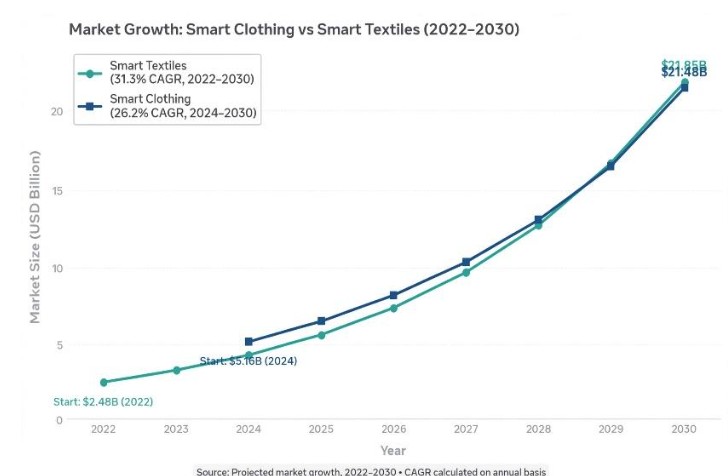
The shift from gadgets to garments is not a prediction — it is already happening in the balance sheets. According to Grand View Research, the smart clothing market stood at $5.16 billion in 2024 and is projected to surge to $21.48 billion by 2030, growing at a powerful 26.2% CAGR. This is not a niche — this is a four-fold expansion in six years. The broader smart textiles sector tells an even more aggressive story. Valued at just $2.48 billion in 2022, it is leaping to $21.85 billion by 2030 at a 31.3% CAGR — nearly 9x growth. This shows that the value is not just in finished clothing, but in the core fiber technology itself.
North America leads with mission-critical applications.The U.S. Department of Defense has invested $317 million into the Advanced Functional Fabrics of America (AFFOA) Alliance, headquartered at MIT. Their focus is not fashion — it is survival: uniforms that detect chemical agents, regulate temperature, monitor soldier vitals, and harvest energy in the field. When the Pentagon funds textiles, it validates the technology as strategic infrastructure. Asia-Pacific, especially Taiwan, is the fastest engine of production. Taiwan held approximately 70% of global technical textiles by 2018 and has only strengthened since then. In 2024,
Taiwan’s textile and apparel production reached NT$333.6 billion with $6.74 billion in exports, powered by global giants like Far Eastern New Century and Shinkong Textile. With innovations like ECO Conductive Ink that uses 85% less water and survives 100,000 twists, Taiwan has moved from being the world’s factory to the world’s laboratory for functional fabrics.
From a hospital bed in Taipei to a running track in Boston, from a soldier’s uniform in the desert to a dress on a runway in Milan — the signal is identical: the future will not be strapped on. It will be woven in.
Also read | Latest Developments in Smart Garments
Conclusion
For ten years, we asked our bodies to adjust to technology. To remember to charge it. To endure the heat, the rash, the weight on our wrist. To live with something that never truly belonged. It buzzed, but it never belonged. Now, for the first time, technology is learning to belong to us. It will breathe like cotton. Bend like silk. Disappear into the clothes we already love.
We started with two bags and a torch on a dark road and a small hope that someday, someone would come and hold the light for us. And now, finally, textile technology held it tight. It took the weight from our tired hands. It didn’t just carry the light — it became the light itself.
References:
- Lee et al., UCLA, Bluetooth Low Energy vs Wi-Fi Power Analysis, 2016.
- Grand View Research, Battery Technology for Wearables, 2023.
- Hwang et al., Skin Modulus and Wearable Comfort, Advanced Materials, 2019.
- Choi et al., Thermal Effects of Wearable Plastics, Nature Electronics, 2020.
- U.S. CPSC, Fitbit Force Recall Notice, 2014.
- Astro Teller, Google X, TED Talk, 2016.
- Holopainen et al., Antenna Miniaturization and SAR, IEEE Antennas, 2020.
- Journal of Power Sources, Samsung Battery Failure Analysis, 2017.
- The Hexoskin smart shirt.
- https://www.sciencedirect.com/science/article/pii/S2211715623005313