

Do you like to prepare line loading plan? But finding difficulties to allocate multiple orders.
In “Line loading plan” planner decides on which date a style
to be loaded and how many lines to be considered for the style to meet the
production completion date.
Line loading plan is an important task for a
production planner. Planner needs to do backward and forward planning based on lead time.
In this article I will explain how to make line loading
plan and what things are important during making a loading plan.
There is lot of mathematical
calculation. So, I will suggest you to use spreed sheet for the making the plan.
Step 1: Make a list
of current orders with details such as order no., order quantity, style
description, and production completion date. Refer to the Table-1. Suppose
order has been received on the month March and production completion date on May
from 4th to 21st.
of current orders with details such as order no., order quantity, style
description, and production completion date. Refer to the Table-1. Suppose
order has been received on the month March and production completion date on May
from 4th to 21st.
Table- 1: Order list
|
Order No.
|
Garment Description
|
Order Quantity
(pieces)
|
Production completion date
|
|
OCS101
|
Dress
|
2000
|
10th
May |
|
OCS102
|
Blouse
|
3000
|
12th
May |
|
OCS103
|
Trouser
|
5000
|
15th
May |
|
GAP104
|
Long sleeve Tee
|
3000
|
17th
May |
|
GAP105
|
Skirt
|
3000
|
21st
May |
|
GAP106
|
Dress
|
1500
|
21st
May |
|
GAP107
|
Long sleeve
Tee |
10000
|
10th
May |
|
GAP108
|
Skirt
|
1200
|
04th
May |
|
Total
|
28,000
|
Step 2: Suppose a
factory has 5 production lines. Calculate available capacity of the line using
capacity calculation formula considering absenteeism (10%) and line efficiency
%. You should have knowledge about line wise production efficiency to
calculate actual capacity of a line. Or calculate it prior to line loading plan.
factory has 5 production lines. Calculate available capacity of the line using
capacity calculation formula considering absenteeism (10%) and line efficiency
%. You should have knowledge about line wise production efficiency to
calculate actual capacity of a line. Or calculate it prior to line loading plan.
Available
capacity in hours = {(No. of operators/machines x working days in a
month x daily work hours x 60) – absenteeism %} x Efficiency %
capacity in hours = {(No. of operators/machines x working days in a
month x daily work hours x 60) – absenteeism %} x Efficiency %
Line wise available capacity has been shown in the Table-2. It is considered that each line is equipped with 25-32 machines
(operators), factory’s normal shift time is 8 hours (480 minutes) and line
efficiency is in the range of 39% to 55%.
(operators), factory’s normal shift time is 8 hours (480 minutes) and line
efficiency is in the range of 39% to 55%.
Table- 2: Available capacity calculation
|
Line No.
|
No. of Operator
|
Minutes/Day
(Daily working Hrs. X 60)
|
Line Efficiency
|
Absenteeism %
|
Capacity available
|
|
Line 1
|
30
|
480
|
40%
|
10%
|
5184.0
|
|
Line 2
|
28
|
480
|
50%
|
10%
|
6048.0
|
|
Line 3
|
32
|
480
|
55%
|
10%
|
7603.2
|
|
Line 4
|
32
|
480
|
45%
|
10%
|
6220.8
|
|
Line 5
|
25
|
480
|
39%
|
10%
|
4212.0
|
Step 3: Next, calculate
required capacity for each order (style) in minutes and in days. Assume that
above 8 styles to be run in 5 lines and styles will be loaded only in single line. Consider that all lines blank and you have no issue with starting date. In
this stage you have to also decide which line to be chosen for the styles. Allocate
order to the line according to product category and line set up (machines laid).
In Table-3 line number has been
mentioned against the order number. Use the following formula for the
calculation.
required capacity for each order (style) in minutes and in days. Assume that
above 8 styles to be run in 5 lines and styles will be loaded only in single line. Consider that all lines blank and you have no issue with starting date. In
this stage you have to also decide which line to be chosen for the styles. Allocate
order to the line according to product category and line set up (machines laid).
In Table-3 line number has been
mentioned against the order number. Use the following formula for the
calculation.
Capacity required in minutes = Order Quantity X Style
SMV
SMV
Capacity required in days = Capacity required in minutes /
Capacity available per day.
Capacity available per day.
Refer to the table-3 for calculated minutes and days
required for each style.
required for each style.
Table-3: Required capacity calculation
|
Order No.
|
Loaded to Line No.
|
Order Quantity
|
Style SMV
|
Capacity Required (Minutes)
|
Capacity available per day
|
Capacity Required (Days)
|
|
OCS101
|
Line-1
|
2000
|
28
|
56000
|
5184
|
11
|
|
OCS102
|
Line-2
|
3000
|
25
|
75000
|
6048
|
12
|
|
OCS103
|
Line-3
|
5000
|
20
|
100000
|
7603.2
|
13
|
|
GAP104
|
Line-4
|
3000
|
10
|
30000
|
6220.8
|
5
|
|
GAP105
|
Line-5
|
3000
|
18
|
54000
|
4212
|
13
|
|
GAP106
|
Line-1
|
1500
|
28
|
42000
|
5184
|
8
|
|
GAP107
|
Line-4
|
10000
|
10
|
100000
|
6220.8
|
16
|
|
GAP108
|
Line-5
|
1200
|
18
|
21600
|
4212
|
5
|
Step 4: Now do
backward calculation to find the date for style loading. Days needed to
complete production on due date, Sundays and holidays must be excluded in day count. And add one to
two days initially for line setting according to style requirement. If required, you can add buffer for one to
two days. To make it easy in calculating the loading dates considering above
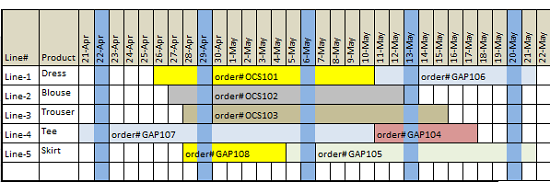
points use spreadsheet based planning board. For example refer to the following image-1. I have
made loading plan on the planning board for theses styles. Light blue colored
columns represent Sunday (weekly off days). Finally make another table (Table-4) representing
loading date against orders.
backward calculation to find the date for style loading. Days needed to
complete production on due date, Sundays and holidays must be excluded in day count. And add one to
two days initially for line setting according to style requirement. If required, you can add buffer for one to
two days. To make it easy in calculating the loading dates considering above
points use spreadsheet based planning board. For example refer to the following image-1. I have
made loading plan on the planning board for theses styles. Light blue colored
columns represent Sunday (weekly off days). Finally make another table (Table-4) representing
loading date against orders.
Image-1: Planning Board
Table-4: Order loading date
|
Order No.
|
Garment Description
|
Loaded to Line #
|
Production completion date
|
Capacity Required (Days)
|
Loading date
|
Comments
|
|
OCS101
|
Dress
|
Line-1
|
10th
May |
11
|
26th April
|
|
|
OCS102
|
Blouse
|
Line-2
|
12th
May |
12
|
27th April
|
|
|
OCS103
|
Trouser
|
Line-3
|
15th
May |
13
|
28th April
|
|
|
GAP104
|
Long sleeve Tee
|
Line-4
|
17th
May |
5
|
11th May
|
|
|
GAP105
|
Skirt
|
Line-5
|
21st
May |
13
|
5th May
|
|
|
GAP106
|
Dress
|
Line-1
|
21st
May |
8
|
11th May
|
|
|
GAP107
|
Long sleeve Tee
|
Line-4
|
10th
May |
16
|
21st April
|
|
|
GAP108
|
Skirt
|
Line-5
|
04th
May |
5
|
28th April
|
|
Step 5: Once you gone through this article, practice this with some of your real styles. I wish you can make it. If you feel you need further assistance then write us.











Leave a Reply