

What is the first thing that comes to your mind when you hear the word knitting? Chances are you aren’t picturing smart textiles made from ordinary knits or knits as Multistable Metamaterials.
Well for me it’s the sweater my grandmother gifted me when I was young. The same goes in the industrial towns of Tripura, Ludhiana, or Gujarat, where giant flatbed knitting machines run all night making that exact comfortable memory.
Now imagine walking into that same noisy factory, using the same machine and telling the machine operator:
Today, we are not going to make a sweater. We are going to knit a light switch.
That sounds like magic right?
Well at Harvard, it just turned to life.
Smart Textiles – The Innovations
A team at the Harvard John A. Paulson School of Engineering and Applied Sciences, led by Dr. Kausalya Mahadevan – a PhD graduate who is now a postdoc in Prof. Katia Bertoldi’s lab – decided to look at a knitted loop not as a textile, but as an engineering brick. Their paper is published in Advanced Functional Materials and is supported by the US National Science Foundation, the Army Research Office, and the Office of Naval Research. Now let’s dive deep to understand this.
Have you ever cut the bottom of an old T-shirt? The edge instantly rolls up. For a factory, that curl is a defect. For a textile artist, it’s just how knits behave. For Kausalya, who loves both textiles and mechanics, that curl was a clue. As she said, her ideas came from watching how textile artists build structures, and mixing it with how the Bertoldi lab thinks about non-linear mechanics. Engineers usually make snappy, shape-holding materials by taking plastic, heating it, and freezing stress inside it with a mold. It’s expensive and needs a factory of molds.
Kausalya’s team asked: What if the yarn itself already has the stress?
They used an old industrial trick called Plating. In plating, the machine knits with two yarns at once, but it is cleverly programmed to keep Yarn A always on the top face and Yarn B always on the bottom face. Both yarns were super-stretchy elastic yarns, but slightly different. So one side of the fabric pulled harder than the other side. Top wants to shrink one way, bottom wants to shrink the other way. The fabric has no choice – it has to curl to relieve that fight. Kausalya put it simply: by choosing the right yarns and the right machine settings, they could make the fabric as “snappy” as physically possible. No heat. No mold. The program itself programs the curl.
But now you may think is a curl smart. So, the answer is No A curl alone is not smart. A light switch is smart.
What is multistable metameterial?
A switch has two homes. It likes to be ON, and it likes to be OFF. It hates being in the middle. In physics, we call this multistability.
The Harvard team discovered that if they knit that curling fabric not as one big sheet, but as stripes – some horizontal, some vertical – the whole fabric became multistable. Modeling every single loop would need a supercomputer. So, they did something clever – they stopped thinking about loops and started treating the whole knitted sheet as one continuous rubber sheet with built-in stress. The simple model predicted the exact moment of the snap. Now, add a wire that is also a Yarn, here is where it turns into electronics, without becoming hard. They knitted in a third yarn – a soft conductive yarn, basically yarn coated with a thin layer of metal. It looks like normal yarn, it stretches like normal yarn, you can wash it, but it carries electricity.
This is what happens next:
- In Shape 1 – curved left – the two conductive tracks are far apart. The circuit is broken. No light. You push. POP.
- Shape 2 – curved right. The snap physically brings the two tracks together. The circuit closes. Electricity flows.
The fabric is the switch. There is no plastic button sewn on top. The switch is the textile itself.
Smart Textiles Exhibited in Harvard Art Lab
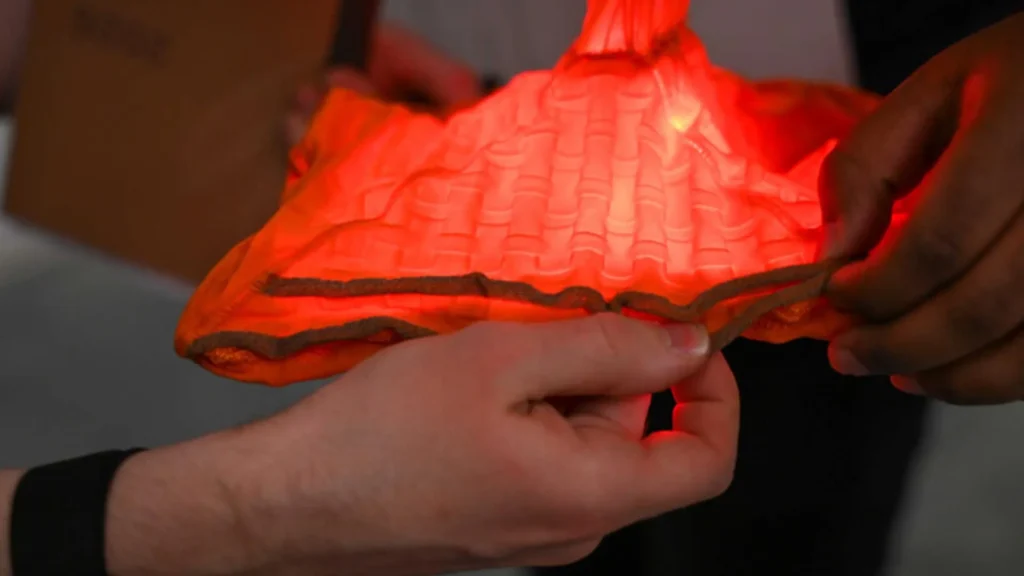
To show the world this wasn’t just a lab trick, they built three objects and even exhibited them at the Harvard Art Lab.
1. The Knee That Counts: A soft sleeve you wear on your knee. Every time you bend your knee – while walking, running, or in physiotherapy – the fabric over the joint snaps. An Arduino, the Rs. 500 computer every engineering student knows, hears that snap as an electrical pulse and counts it. No battery-hungry chip, no hard fitness band. Just your sleeves counting your steps.
2. The Breathing Shell: A small knitted dome. Leave it alone, the LED is off. Press it down, it snaps and the LED turns on. Press it again, it turns off. It feels incredibly satisfying, like popping bubble wrap that controls light.
3. The Lampshade That Paints: This is the showstopper. In the photo from Harvard SEAS, you see one seamless knitted lampshade. But its bottom edge hides three different snapping zones. Snap zone one, the lamp glows red. Snap zone two, green. Snap zone three, blue. Snap two together and you get mixed colors. One piece of cloth, three independent switches.
Why This Matters for the world of Smart Textiles.
“The machines used are similar to the industrial knitting equipment already found in garment factories.”
Most “smart textiles” die in the lab because you need a clean room, electrospinning, or a machine that costs crores. This needs a Stoll or Shima Seiki machine – the exact machine already running in thousands of factories across India. You don’t need a new factory. You just need to upload a new program. For a country that makes the world’s sweaters, this is a ladder from low-margin garments to high-value programmable materials. What was once considered a defect – that annoying curl of a T-shirt – is now a functional building block. The loop is no longer just to keep you warm. The loop is a mechanical computer.
Conclusion
In conclusion, it is clear that Harvard SEAS has fundamentally redefined knitting, transforming it from a craft of comfort into a scalable platform for nonlinear mechanical metamaterials and smart textiles.
Led by Dr. Kausalya Mahadevan in Prof. Katia Bertoldi’s lab, the team has demonstrated that by exploiting Plating— programming two disparate elastic yarns onto opposite faces of a fabric using conventional Stoll and Shima Seiki machines — it is possible to engineer asymmetric residual stress that drives spontaneous curling. By arranging these restressed domains into orthogonal stripes, they achieve programmable multistability, where the textile snaps and holds between two distinct states, much like a soft logic gate.
By replacing intractable loop-by-loop simulations with an elegant continuum elastic sheet model that accurately predicts snap-through, and by integrating washable conductive yarns as intrinsic contacts, the fabric itself becomes a soft, seamless, and electronics-free switch. This concept was validated through three prototypes: a self-counting knee sleeve for low-power motion tracking, a bi-stable dome for tactile LED control, and a single-knit lampshade with three independent RGB switches.
The work proves that function can emerge from geometry, and that the humble knit loop can be engineered as a mechanical unit cell, instantly scalable on existing garment factory infrastructure. This is the future envision of the scientists: clothes that remain soft and seamless, yet are truly functional — bandages that self-adjust compression, garments that become more breathable the moment you sweat, and VR gloves that deliver a soft tap instead of a hard vibration.
Reference
- Kausalya Mahadevan. et.al “Knitting Multistability“ (2026),Advanced Functional Materials
- https://seas.harvard.edu/news/oh-snap-fabrics-multiple-stable-shapes
- https://www.sciencedaily.com/releases/2026/09/260901070543.htm









Comments (1)
Shreksays:
September 28, 2026 at 3:23 amAfter reading I feel this will be useful in robotics.
I can see the Terminator wearing Multistable Fabric and coming for us 🥰🥰.