

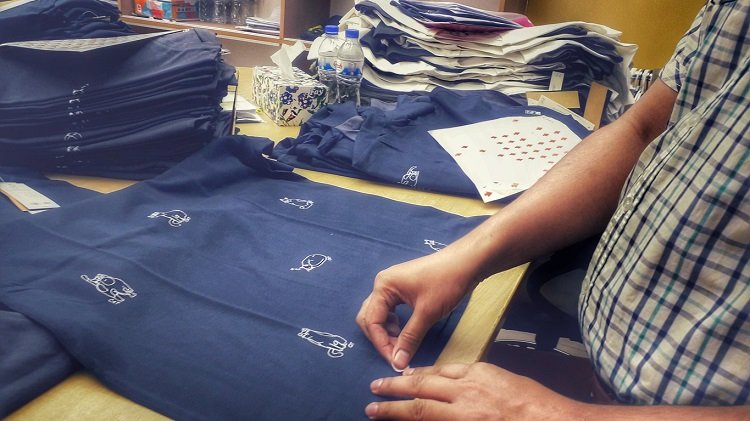
Ever wondered how quality control teams decide whether a batch of 10,000 t-shirts is ready for retail shelves? They don’t check every single shirt—that would take forever and cost a fortune. Instead, the apparel industry relies on a precise, standardized methodology to pull just the right number of samples. This is called sample size for the inspection of an order or a production lot.
Whether you are launching your first apparel line or scaling up factory quality checks, mastering AQL (Acceptable Quality Limit) inspection standards—governed by ISO 2859-1 / ANSI/ASQ Z1.4—is essential to ensuring top-tier craftsmanship.
Here is a simple, step-by-step guide to calculating garment sample sizes like a pro.
Step 1: Count Your Total Lot Size
Start with the total quantity of finished units in the specific shipment or production run. For instance, let’s say your factory just completed a batch of 5,000 polo shirts.
Step 2: Select Your Inspection Level
Inspection severity dictates how thoroughly you sample a shipment. International standards define three general levels:
- Level II (General Default): The standard benchmark used across 90%+ of global garment quality checks.
- Level I (Reduced Inspection): Used for lower budgets, time-sensitive shipments, or factories with proven track records.
- Level III (Tightened Inspection): Used for high-end luxury garments, complex builds, or high-risk suppliers.
Step 3: Find Your Code Letter
Using the international standard Sample Size Code Letter Table, cross-reference your Lot Size against your Inspection Level (AQL Inspection):
Table-1: Code Letter based on Lot Size and General Inspection Level
| Lot Size (Garments) | General Level I | General Level II (Standard) | General Level III |
| 151 to 280 | F | G | H |
| 501 to 1,200 | H | J | K |
| 1,201 to 3,200 | J | K | L |
| 3,201 to 10,000 | K | L | M |
| 10,001 to 35,000 | L | M | N |
Step 4: Determine Your Sample Size & Pass/Fail Thresholds
Once you have your code letter, match it on the AQL Sampling Table to determine your exact sample size. Then, compare your findings against industry-standard defect limits:
- AQL 0: Critical Defects (e.g., exposed needles, broken sharp metal) –> Zero tolerance.
- AQL 2.5: Major Defects (e.g., incorrect sizing, open seams, prominent stains).
- AQL 4.0: Minor Defects (e.g., loose threads, minor print placement errors).
Table-2: Showing Code letter, Sample Size and Pass/Fail Defective unit in different AQL level
| Code Letter | Sample Size to Inspect | AQL 1.0 (Strict) Pass / Fail | AQL 2.5 (Industry Std – Major) | AQL 4.0 (Minor) |
| G | 32 pcs | Pass = 0 | Fail >=1 | Pass <= 2 | Fail > =3 | Pass <= 3 | Fail >= 4 |
| J | 80 pcs | Pass <= 2 | Fail >= 3 | Pass <= 5 | Fail >= 6 | Pass <= 7 | Fail >= 8 |
| K | 125 pcs | Pass <= 3 | Fail >= 4 | Pass <= 7 | Fail >= 8 | Pass <= 10 | Fail >=11 |
| L | 200 pcs | Pass <= 5 | Fail >= 6 | Pass <= 10 | Fail >= 11 | Pass <= 14 | Fail >= 15 |
| M | 315 pcs | Pass <= 7 | Fail >= 8 | Pass <= 14 | Fail >= 15 | Pass <= 21 | Fail >= 22 |
Example of Sample Size Calculation
Let’s look at a real-world scenario in the following example:
- Total Order: 5,000 t-shirts (lot size) and inspection to be done full order in a single inspection.
- Inspection Standard: Level II Standard. Chose you inspection level from options (Level I, II, III).
- Code Letter: Matches to Letter L.
- Action: Pull 200 garments at random across different cartons.
- Verdict: At AQL 2.5, if you find 10 or fewer major defects, the shipment passes. If inspectors find 11 or more, the entire lot is rejected for factory re-work.
By implementing this systematic sampling approach, you can maintain consistency, manage supplier accountability, and keep your customers happy.
Sample Size Calculation (Calculator)
Garment AQL Sample Size Calculator
Standard ANSI/ASQ Z1.4 (ISO 2859-1) Sampling






Leave a Reply