

Introduction
The garment industry is now more interconnected than ever, as the introduction of advanced technologies in sewing machines, automation of material handling, computerised cutting equipment, and advanced production control platforms takes place. Such technologies might offer many benefits in terms of quality and productivity increases, but they also create new forms of interaction between human operators and machines, which need to be managed carefully from the perspective of ensuring machine safety. Traditional risks of moving blades, needles, belts, rollers, hot parts, noise, electricity, and other elements of the production environment persist in the industry. Thus, the machine safety market is now moving towards advanced solutions based on the integration of sensors, automation, AI, and monitoring.
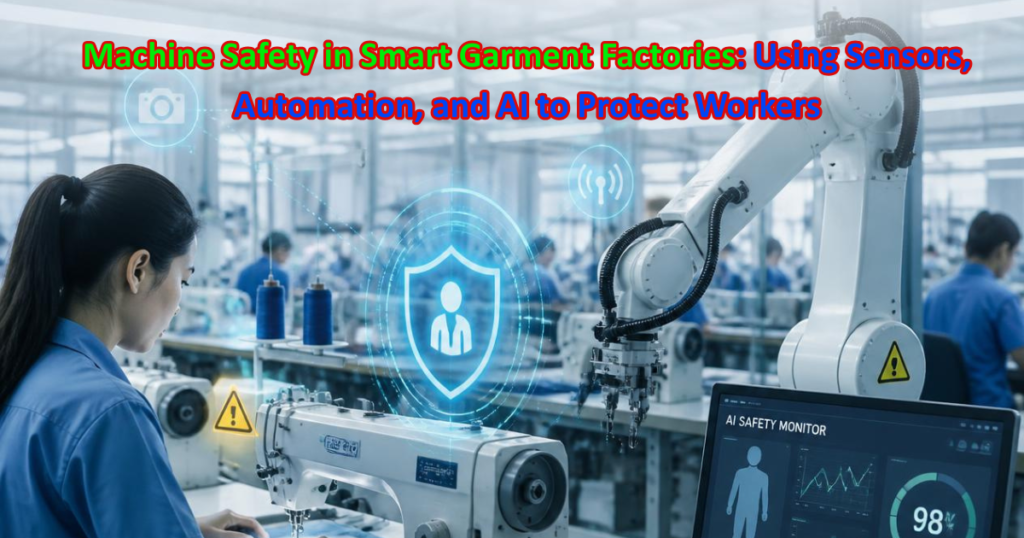
Real-Time Hazard Detection by Intelligent Sensors
Sensors have increasingly become an essential component of machine safety systems, as they allow machines to be able to sense any change in their operational environment rather than depending on the traditional method of conducting visual inspections. In the garment industry, sensors can measure machine access, temperature, vibrations, pressure, movement, and guarding position. They will only be beneficial if the information from the sensors is used along with the right safety controls that can stop or slow down the equipment in case of a hazardous condition. According to the guidance provided by the International Labour Organization on machinery, suitable controls, guards and protection are crucial components of any occupational safety program.
Presence and Proximity Detection
Proximity sensors and light curtains can sense when a worker moves into the danger zone. When the sensors are integrated with the safety control system of the machine, they can help stop the machine in a controlled manner. It will also help prevent the start of the hazardous cycle.
Condition Monitoring Sensors
These types of sensors include vibration, temperature, current, and pressure sensors, which can detect any abnormal behaviour of machines before it leads to machine failure. For instance, a vibrating sewing machine may imply mechanical wear or misalignment. Early detection of such situations can prevent unexpected equipment failures as well as secondary dangers arising from damaged equipment.
Guard and Interlock Monitoring
Intelligent interlocks can detect whether safety guards, machine doors, and machine covers are properly closed before any dangerous movement. This will add another level of safety if there is a need to access machines. Such systems should be used to supplement but not to replace physical guarding and safe working practices.
Environment Monitoring
The sensors will monitor environmental elements such as temperature, dust, humidity, lighting, and noise. These are not intended to replace official work environment assessments, but rather will assist safety personnel in pinpointing areas where the working environment is deteriorating. Additionally, constant monitoring provides a useful database for troubleshooting issues that persist.
Automation and Robotics to Enhance Safety
Automation may allow removing staff from some of the most tedious and dangerous jobs during garment manufacturing. Automation of cutting, fabric conveying, material feeding, pressing and packing operations can prevent direct exposure to sharp objects, monotonous labour, heavy lifting and operating the machinery. Automation shifts the danger profile of the job, and new dangers related to unexpected movement of machines, potential programming mistakes, maintenance activities, and interaction between humans and automated machines may arise. Hence, assessment of hazards and risks should be done at all stages of machinery’s operation. ISO 12100 presents the procedure for hazard identification, risk estimation and evaluation and risk reduction methods during machinery design and operation.
Automated Material Handling
Conveyor lines, automated guided conveyors and robotic equipment can ease fabric bundle handling and minimise ergonomics-related problems. Still, proper routes of movement, emergency stop mechanisms, protective devices and segregation of people from moving equipment remain essential.
Robotic Cutting and Processing
Automated cutting tools are capable of carrying out repetitive tasks more reliably while keeping employees at a safer distance from the exposed blades. Safety in this case depends on the design of the enclosure, access controls, emergency stopping system, maintenance processes, and adequate detection systems. Workers also need to know when the system is powered up and what conditions are required before entering a restricted area.
Collaborative Automation
Collaborative robots have been made specifically for particular interactions with human beings; however, collaborative applications involve the process of risk assessment. Speed, force, tooling, payload, layout of workspace, and possible actions of humans affect risk level. In this regard, collaborative applications should be tailored according to the specific task, as people tend to think that all collaborative robots are absolutely safe.
Emergency Controls in Automated Systems
Intelligent manufacturing lines allow linking emergency stops, safety control systems, interlocking systems, and machine control into safety functions. This will minimise the time needed to detect the hazard and shut down the equipment. Despite that, emergency controls should always remain accessible, identifiable, tested, and reported upon.
Artificial Intelligence and Predictive Safety
AI can help to take machine safety from being reactive to predicting potential problems. AI systems can analyse massive amounts of data and spot patterns of activity that correspond to problems with machines, such as unsafe operations and maintenance needs. In this way, in the smart garment factory, safety personnel may be able to progress from a mostly reactive approach to a more preventative one. However, AI should assist human decision-making rather than become the only one responsible for critical decisions in terms of safety. False positives, limited training sets, faulty sensors, as well as changes in production conditions, might impact the reliability of algorithms.
Predictive Maintenance
By using machine learning, algorithms could monitor vibrations, temperature, energy consumption, cycle counts and many other parameters and identify behaviour of equipment that can lead to failure. This allows to perform maintenance to prevent failure of potentially dangerous equipment.
Hazard Detection by Computer Vision
The combination of cameras and computer vision technology can recognise various scenarios like entering restricted zones, absence of protective equipment, or strange movements around machinery. In appropriate cases, such systems can trigger alarms to notify the managers or implement predetermined safety actions. However, these technologies need to be applied taking into account issues related to light, obstruction, accuracy, privacy, and the outcomes of false negatives.
Incident and Near-miss Analysis
AI can recognise patterns that happen in incidents or near misses recorded in incident reports, machines’ alarms, maintenance logs, and near-miss reports. Rather than considering every incident separately, safety experts can use the data obtained from those sources to find out common factors.
Human Supervision of AI Decision-making
Safety-critical applications of machine learning need clearly defined limitations concerning what the system can and cannot do. Algorithms need to be validated against certain performance criteria, continuously monitored for potential accuracy degradation, and supplemented by traditional safeguards. No safety system should assume that a machine learning prediction is accurate just because it is based on big data.
Occupational Health and Safety Management Through Technology and Worker Protection
Technology becomes really powerful if it works within an overall health and safety management system. The sectoral code of practice of the ILO dealing with machinery, physical hazards, ergonomics, training, personal protective equipment, and health and safety management for the textiles, clothing, leather, and footwear industry mentions that cooperation between governments, employers, workers, and their organisations is very important.
Digital Risk Assessments:
There are electronic platforms for risk assessment that contain data on machinery, hazards, control measures, inspections, and corrective action. It is easy to see if identified risks have actually been managed. Risks assessment should be updated each time there are any changes concerning machinery, processes, layout, computerised systems, and production.
Systems for Connected Training:
Training applications may provide specific machine instructions, interactive learning, progress tracking, and additional training sessions. Employees can get access to relevant information about the machine they work with, instead of getting general safety information. Nevertheless, practical training remains an essential element that must be included in any program.
Reporting and Feedback by Employees:
With mobile reporting systems, suggestion programs, and recording of near misses electronically, employees will be able to report any risks more easily. This tool is efficient only when the reported information is analysed quickly, and the employee trust is high enough. Effective safety culture implies that worker observation is an important source of information.
Integrated Safety Dashboards:
By using dashboards, managers will be able to track machine alarms, inspection status, overdue maintenance, incidents, and other measures for risk reduction. Properly designed dashboards allow organisations to recognise trends and do not display only the amount of information. The objective should be better decision-making, not increased surveillance of workers.
Challenges, Standards, and the Future of the Machine Safety Market
Smart safety solutions provide many advantages; however, the implementation of these solutions brings with it many challenges related to technology, finance, cybersecurity, and privacy. The upgrading of the older equipment might be too expensive, whereas the connected devices will require good cybersecurity practices. According to the ILO, the approach to systematic prevention and efficient safety management needs to be followed in the garment industry.
- Retrofitting of Legacy Machinery: Existing machines may not have sophisticated safety interfaces. The installation of additional sensors, guards, and interlocks will enhance safety; nevertheless, any changes need to be evaluated to ensure that no new risks are created in the process.
- Functional Safety: Connected machinery introduces cyber security threats that may disrupt safety operations. Networking, access controls, software updates, testing, and backups become vital in this case.
- Monitoring and Data Privacy: Safety cameras and wearables assist in identifying risks; however, they may raise privacy concerns. Factories need to set up protocols regarding the processing of safety data.
From Machines That Connect to a Culture of Prevention
Smart garment manufacturers offer an example of how technology can contribute to making workplaces safe through its integration into a proper engineering approach and appropriate management. Sensors may be used for detecting risks, automation will minimise risks associated with certain repetitive or potentially dangerous operations, and AI will help recognise patterns that can facilitate preventive measures. Nonetheless, technology cannot make a workplace safe by itself. Physical barriers, emergency mechanisms, maintenance, worker education, risk assessment, and proper management are all crucial components. According to the recommendations provided by the ILO for the sectoral industry, a preventive approach implies a need for broader participation in workplace issues rather than relying on technological solutions.
According to Pristine Market Insights, the future of the machine safety market will necessarily revolve around a more efficient functioning of all these technologies while maintaining human control over them. A truly smart factory is not just a factory where machines interact with each other; it is a place where safety information is translated into effective measures taken, and workers play a significant role in the decision-making process.







Leave a Reply