

A technical auditor walks a garment plant on a Tuesday morning and asks for the fusing press records. The plant produces a setting sheet — temperature, pressure, dwell, initialled by the supervisor at shift start. Then the auditor asks what the press was actually doing on the panels that shipped in the middle of the run. Nobody can answer. The machine was never bought with an answer in it.
Most industrial engineers have watched some version of that morning. The corrective action gets written up as a procedure: more frequent checks, a second signature, a log sheet clipped to the machine frame. The procedure closes the CAPA. It does not produce the missing record, because the missing record was a line item in a capital equipment specification that nobody wrote three years ago, and it cannot be retrofitted for any sensible amount of money.
Recording capability is a purchase decision. Sensors, control architecture, data storage and file output are designed into a machine at order time and priced into the quotation. Bolt them on afterwards and you are funding a second engineering project on a machine that was never laid out for one — assuming the builder will even quote the work.
To make that argument visible, this article uses machinery from an industry most apparel engineers have never set foot in: hydraulic bucking units, which oilfield workshops use to assemble threaded pipe. The unfamiliarity is deliberate. Take away everything you already know about sewing rooms and fusing lines, and the procurement logic has to stand on its own. It does. Then it transfers back to your floor with very little translation.
What this article covers
- Why capital equipment specification decides what you can prove years later
- The worked example: hydraulic bucking units in an oilfield workshop
- Why a passing final number can sit on top of a failed process
- Matching instrumentation grade to the cost of an undetected failure
- Reading the certificate scope instead of the certificate logo
- Checking that a quoted accuracy figure belongs to the grade you are buying
- Utilities, footprint and floor loading — the lines that vanish from an RFQ
- Clause language you can paste into a purchase order
- What all of this looks like back on the garment floor
- Frequently asked questions
Capital equipment specification decides what you can prove later
A quality system asks three things of any process. Was it capable. Was it in control. Can you show it.
The first two are engineering problems and you already own them. The third is an evidence problem, and evidence has to come from a physical thing that was watching. A machine either generates a per-unit record or it does not, and which of those it does was settled by whoever wrote the technical annex to the purchase order.
Consider what retrofitting actually involves on a machine that shipped without recording. There is no mounting provision for the sensor, so someone fabricates a bracket, which changes the load path. There is no spare analogue input on the controller. There is no cable route that keeps a signal cable away from a drive cable. There is no software layer to time-stamp anything, associate it with a work order, and write a file. And the moment you cut into the machine, the builder’s warranty conversation gets complicated and the validation burden lands entirely on your engineering team.
None of it is exotic engineering. Just expensive, slow, and undertaken at the worst possible moment — usually while a customer waits on a corrective action response.
The discipline, then, is to treat capital equipment specification as a records question from the first draft of the RFQ. Before comparing prices, write down what the machine has to have produced by the time a unit leaves it, in what format, retained for how long, retrievable by whom. Then buy a machine that does that as delivered.
A worked example from an industry you do not work in
Oilfield tubulars — casing, tubing, drill pipe — are joined by threaded connections. Traditionally those connections were made up on the rig floor with tongs, in weather, at whatever pace the rig was running. The workshop alternative is a hydraulic bucking unit: a horizontal machine that clamps one component, rotates the other, and makes up or breaks out the connection as a controlled indoor process.
Galip Equipment, the trading name of Dezhou Zhuorui Petroleum Machinery Co., Ltd., builds these in a published range of frame sizes — 10″, 15″, 18″, 20″, 22″ and 24″, with custom builds to 32″ — handling pipe from 1-5/8″ to 24″ outside diameter. Across that whole range, torque capability spans 500 to 199,000 ft-lb, in make-up and in break-out, with fully rotational 360-degree operation. The same company builds dedicated breakout units and drilling jar testers on the same principle.
Two delivered examples show how wide a single product family stretches: a 32-inch fully rotational unit went to a workshop operator in Oman, and a 10-inch fully rotational unit was delivered in Singapore. Those are machines with almost nothing in common dimensionally, sold under one product description.
Clamping architecture is one of the few build claims a visiting buyer can inspect with their own eyes.
An apparel engineer should recognise the underlying move immediately. A critical joining operation that used to happen in an uncontrolled place, at variable speed, judged by operator feel, gets pulled into a fixed cell where the process can be instrumented and the output recorded. That is the same reasoning behind moving a critical seam to a dedicated automat, or taking metal detection off a hand-held wand and onto a fixed tunnel.
What matters for our purposes is the record. The machine records torque against rotation and produces a chart for every single connection it makes. That chart is retained, exportable and auditable — one file per joint, available to anyone who asks about that joint later.
When the final number tells you nothing
Here is the failure mode that makes the record worth paying for, and it is ordinary physics that anyone in the industry will confirm.
Threaded connections can gall. The mating threads pick up metal, tear, and seize against each other. A galled connection binds as it turns, and the resistance the machine feels comes from damaged metal dragging on damaged metal.
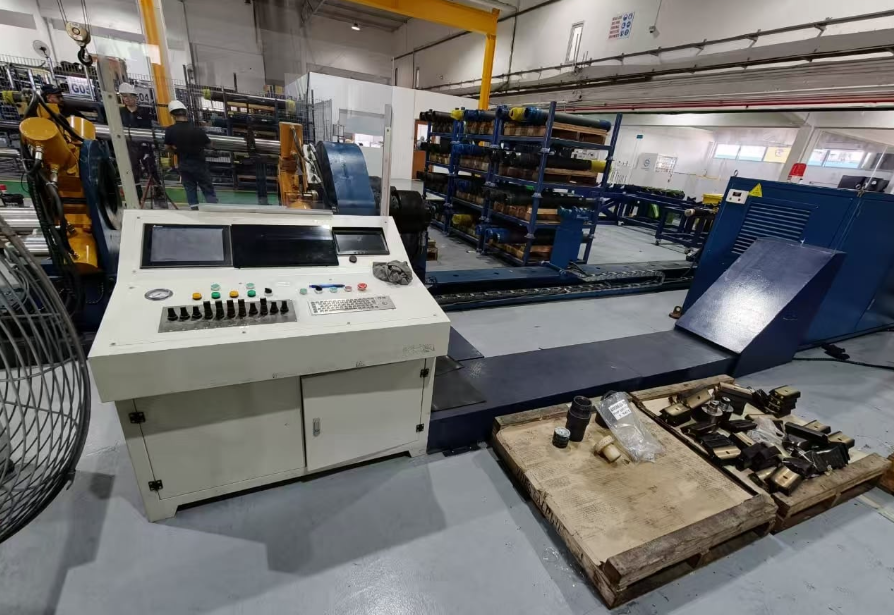
On the instrumented grades the machine writes its own record of every connection, automatically, rather than an operator writing a figure on a tally sheet.
The everyday analogue is a cross-threaded bolt. It does not run free — it binds hard, the wrench reads high, and you can drive it to the specified figure on the torque wrench while the fastener and the hole are being destroyed. The number on the wrench is honest. It is also useless on its own.
Every plant has an operation shaped like this. Anywhere your acceptance evidence is one number captured at the end of a cycle, you are exposed to the same class of problem: a process that went wrong in the middle and still landed on an acceptable endpoint. The equipment either kept the shape of what happened, or it kept only the verdict. Which of the two it does was fixed by the capital equipment specification, and it was fixed once.
Match the instrumentation grade to the cost of an undetected failure
Suppliers of serious capital equipment usually offer the same machine in several control grades. The tiers reflect a real engineering choice, and getting that choice wrong in either direction costs money.
The bucking units are offered in three. Lever grade is manually controlled with a basic torque display: no HMI, no automatic clamping, no automatic reporting. Proportional grade runs a pre-programmed torque and turn profile, clamps automatically, carries an industrial HMI, and produces Excel and PDF output automatically, with a recipe system and a historical database behind it. Precision grade adds a dual-screen operator station, an HBM load cell and a Beckhoff PLC on top of that.
| Control grade | Operator interface | Clamping | Record produced | Stated torque accuracy (20-inch class) |
| Lever | Manual control, basic torque display, no HMI | Manual | None automatic | ±250 ft-lb maximum |
| Proportional | Industrial HMI, pre-programmed torque/turn profile | Automatic | Automatic Excel and PDF, recipe and historical database | ±250 ft-lb maximum |
| Precision | Dual-screen station, Beckhoff PLC | Automatic | Automatic Excel and PDF, recipe and historical database | ±150 ft-lb, with HBM load cell |
Selecting between them is where a capital equipment specification stops being paperwork and starts being industrial engineering. Estimate the cost of one undetected bad unit escaping — rework, recall, scrapped downstream assembly, a customer chargeback, a claim — and multiply by a defensible escape rate. Compare that to the price step between grades, amortised over the life of the machine.
In an oilfield workshop the cost side of that comparison is brutal: a connection that fails downhole is expensive to reach. So the arithmetic lands on an instrumented grade almost immediately.
In a garment plant the same arithmetic can legitimately land on the cheap grade. If the operation feeds an internal process step, the defect is visible at the next station, and the worst outcome is a few minutes of rework, buying a data-logging premium is waste. Specify the manual grade and spend the difference where the escape actually hurts. What you must not do is pick a grade by budget line alone and then discover, at audit, that the grade you bought was never able to produce the record your quality manual promises. A capital equipment specification that names a required record without naming the grade that generates it is an unfunded promise.
Read the certificate scope, not the logo
Certification is the part of vendor assessment most often done by pattern-matching. A logo appears in the proposal, a box gets ticked, and nobody opens the certificate.
Open it. A management-system certificate has a scope statement, and the scope statement is the entire content of the document. It names what activities at what site the audit actually covered.
Take the worked example again. Dezhou Zhuorui holds ISO 9001:2015, with the certificate scope reading “Hydraulic disassembly frame, screw drill, screw drill machine test platform processing.” That is a defined scope covering defined product types. It is not a blanket certification of everything the company might ever build, and a buyer who reads it that way has misread it.
Two more distinctions from the same example, both of which have direct analogues in apparel sourcing.
The company does not hold an API Q1 certificate. If your specification requires one, that requirement is unmet, and no amount of adjacent documentation changes it.
Separately, the machines are used on API 5CT casing and tubing. That describes an application — what the equipment gets used on. A licence held by the manufacturer is a different animal, and the two get blurred constantly in marketing copy, in every industry. In apparel you meet the same blur when a mill’s test report for one fabric construction is presented as though it certified the mill’s entire output, or when a certificate covering one production site is offered for goods made at another.
A workable rule for any capital equipment specification: name the standard, name the required scope wording, and require the certificate number and issuing body in the quotation itself, so the check happens during evaluation and not during an audit.
Check that the quoted number belongs to the grade you are buying
This is the most common technical error in equipment evaluation, and it survives because everything involved is true.
Look again at the torque figures above. The published range spans 500 to 199,000 ft-lb. That figure is correct — and it describes the range, from the smallest frame to the largest custom build. No single machine is rated at 199,000 ft-lb. Quote the top of a catalogue range as though it were one machine’s rating, and you have written a specification that nothing in the range satisfies.
Now the same trap at finer resolution. One machine in the 20-inch class chucks from 2-3/8″ to 20″, develops a maximum torque of at least 100,000 ft-lb, and rotates at 0.5 to 5 rpm. Its torque accuracy is quoted as ±250 ft-lb maximum on the lever and proportional grades, and ±150 ft-lb on the precision grade only.
The ±150 ft-lb figure is real. It belongs to the grade with the HBM load cell in it. Write ±150 ft-lb into your specification, then buy the proportional grade because it was cheaper and had the reporting you wanted, and you have bought a machine that does not meet your own written requirement. You will find out when someone reconciles the specification against the delivered machine, which is usually at the worst time.
So the check is mechanical, and it takes a minute. For every performance number you copy out of a datasheet, write next to it which configuration it belongs to. Range figure, or single-model figure. Base grade, or top grade. Then confirm that the configuration on the purchase order is the one that carries the number.
The specification lines that vanish from an RFQ
Recording capability gets the attention in this discussion because it is the one that fails silently. The lines below fail loudly, on delivery day, and they go missing from a capital equipment specification with remarkable regularity.
Electrical supply, with its tolerance band. The example machine runs on 380 V ±10%, three-phase, 50 Hz. The tolerance is the useful part: ±10% around 380 V spans roughly 342 to 418 V, which quietly determines whether a plant on a different nominal supply is inside or outside the envelope. A 60 Hz plant is a separate conversation entirely, and one to have before the order rather than after.
Cooling method. This machine is air cooled only. Plants that assumed a chilled-water tie-in, and plants that assumed no heat rejection into the workshop, both need to know that before the layout is frozen.
Mass and footprint, as delivered. The skid measures approximately 6,500 x 2,250 mm and weighs approximately 12,600 kg. That is a rigging plan, a door width, a floor route and possibly a crane, none of which appear on a datasheet.
Installation envelope, which is not the same as footprint. The machine needs roughly 13-14 m x 5-6 m of clear floor to work in, because pipe has to be handled in and out along the axis. Required floor loading is 750 kg/m2.
The machine on its skid. The clear floor it needs along the pipe axis is roughly twice the skid length, which is the figure that decides whether a bay will work.
One detail there is worth borrowing as a question you ask of every heavy machine you buy. This unit stands on levelling feet, with no floor levelness specification and no ground anchors required. That removes a civil works package, a concrete cure delay and a foundation drawing from the project — and it makes the machine relocatable if the workshop layout changes later.
Most heavy equipment does not behave that way. Ask early, because a foundation requirement discovered after the order turns a delivery date into a construction schedule.
Clause language you can paste into a purchase order
Specification discipline collapses into vagueness unless the requirement is written as something a supplier can either meet or decline. These are the clause shapes worth carrying into any capital equipment specification where records matter.
- Name the record, per unit. “The machine shall generate and store a process record for every unit processed, without operator action to initiate it.” Automatic beats operator-triggered, because operator-triggered records go missing on the shift where it matters.
- Name the file format and the export path. Excel and PDF output, exportable to a named location. If the data only exists inside the vendor’s proprietary viewer, decide now whether you accept that.
- Name retention and capacity. How many records the on-board database holds, what happens when it fills, and whether it overwrites silently.
- Name traceability fields. The record has to carry work order, operator, machine identity and time stamp, or it cannot be tied back to the units it describes.
- Name the accuracy figure and the configuration it belongs to. Written as one clause so it cannot be separated in negotiation.
- Name the certificate, the scope wording and the number. Required in the quotation, not on delivery.
- Name the acceptance test. What you will run at factory acceptance and site acceptance to demonstrate that each of the clauses above is satisfied by the machine actually delivered.
That last clause is what gives the other six force. A requirement with no acceptance test attached rarely survives the commercial negotiation, and never survives commissioning week.
What this looks like back on the garment floor
Nothing above depends on tubulars. Walk your own floor and the same questions apply to equipment you are already running or about to quote.
Fusing presses: does the machine record what the belt actually did across the run, or does it display a setpoint and trust it? Needle detectors and metal detectors: is the pass event logged per bundle with a time stamp, or does the operator write a tally on a sheet? Bar tack and pattern automats: is cycle data retained per unit or discarded at the end of the cycle? Boilers, calenders, dryers, laser units, automated cutters — all of them make the same choice at purchase.
The pattern is consistent across every one of them. The record is cheap when it is a line in a quotation and extremely expensive at every later point. And the day you need it, you cannot buy it retroactively at any price, because the units in question have already shipped.
Industrial engineers are usually pulled into equipment projects to work on cycle time, throughput and layout, and those are the right things to work on. The suggestion here is narrower: take the technical annex as well. Own the paragraph that says what the machine has to produce as evidence, because when it goes missing, the corrective action lands on your desk anyway.
A good capital equipment specification is mostly a list of decisions made early enough to be cheap. Recording capability is the one on that list with the longest tail, and the one most often left off.
Frequently asked questions
Can we add data recording to a machine we already own?
Sometimes, at a price that surprises people. The sensor is rarely the problem; the mounting provision, spare controller inputs, cable routing, software layer and revalidation are. Get a written quotation from the original builder before assuming it is feasible, and compare it against the price step you would have paid for the instrumented grade at order time. The comparison is usually uncomfortable, which is the argument for getting the capital equipment specification right the first time.
How do we decide which instrumentation grade to buy?
Work from the cost of the failure, not the price of the feature. Estimate the cost of one undetected defective unit reaching the point where it does damage, multiply by a defensible escape rate over the machine’s life, and compare that to the price step between grades. Where the defect is caught at the next station and costs minutes, the manual grade is the correct engineering answer. Where the defect escapes to a customer or into an assembly, buy the record.
A supplier says the machine is ISO 9001 certified. Is that enough?
It is a starting point, and treated as a conclusion it will mislead you. Read the scope statement on the certificate — it names the activities and the site the audit covered, and it is often narrower than the supplier’s full product line. Ask for the certificate number and issuing body during evaluation. Also separate what the equipment is used on from what the manufacturer is licensed for; those are different claims and they get presented interchangeably in every industry.
Should engineering or purchasing own the technical annex?
Engineering writes it, purchasing enforces it, and the two have to agree on what is a hard requirement and what is a preference before quotations arrive. The common failure is a capital equipment specification written as a wish list, which lets negotiation trim exactly the items with no acceptance test attached — and recording capability, having no visible effect on day-one throughput, is almost always the first thing trimmed.
A Quick Note: We love sharing diverse perspectives from our community! Just a heads-up that this is a guest post. The thoughts, advice, and ideas shared here belong entirely to the author and don’t necessarily represent the stance of Online Clohing Study. While we only publish stuff we think you’ll love, always remember to do your own research before making any big decisions based on what you read!











Leave a Reply